
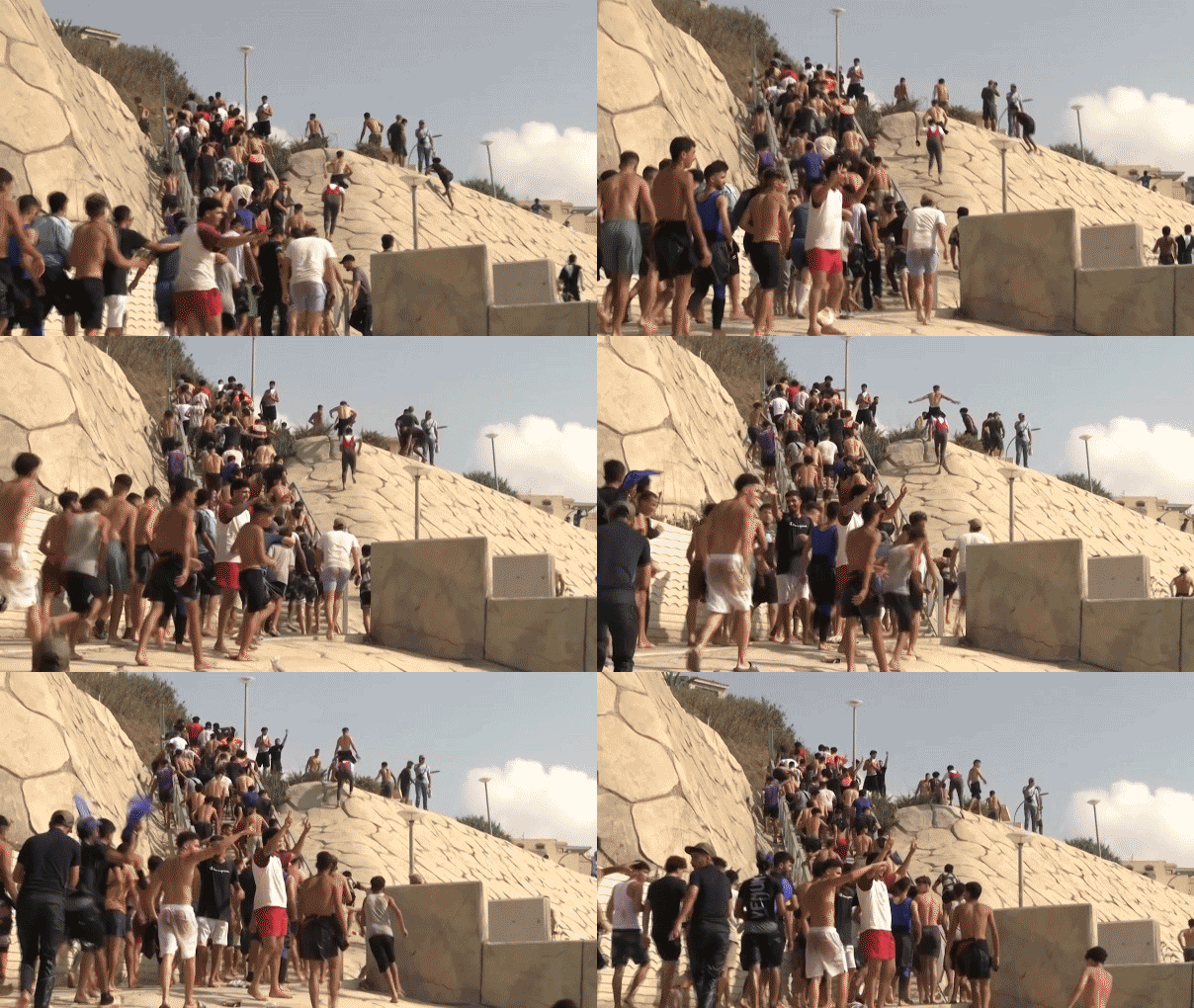
President Donald Trump also seized on the images from Spain, warning during a Cabinet meeting at Camp David, Maryland, Friday that a similar crisis could unfold in the United States if Republicans lose power.
"I saw Spain yesterday, and I watched the catastrophe that took place," Trump said.
"That same thing is going to happen to us if the Republicans don’t get elected — except worse," he said, blaming "weak law, bad management" and liberal migration policies.
The breach also ignited a broader conservative backlash across Europe and the United States.
Italian Prime Minister Giorgia Meloni said in a post on X that Italy would impose targeted checks on non-European Union nationals arriving from Spain by air or sea for one month, while coordinating with France to strengthen controls along the Franco-Italian border.
"This is an extraordinary measure, adopted to safeguard national security and prevent possible repercussions for our nation," Meloni wrote.
She said the controls would remain in place only as long as necessary and would be designed to limit disruption to summer tourism.
"I think we are witnessing the beginning of the end of the European Union," he said while acknowledging that his view remains outside the European mainstream. "Once you unravel Schengen — which I think is inevitable — this breaks down the entire European project."
Mark Dubowitz, CEO of the Foundation for Defense of Democracies think tank, broadened the criticism of Sánchez.
"We told you Sánchez was a disaster," Dubowitz wrote on X. "You dismissed the warnings because he vilified Israel, defended Hamas, attacked America, and cozied up to Chávez, Khamenei, and other anti-American dictators. Now that his migration policies are threatening Europe at home, you’ve suddenly woken up."
Ceuta is legally part of Spain despite being located on the North African coast, across the Strait of Gibraltar from mainland Spain. The approximately seven-square-mile territory shares a land border with Morocco and is one of two Spanish autonomous cities in Africa, along with Melilla.
Ceuta, Spain, is not a protectorate or colony. Its residents are Spanish citizens, and Madrid considers it an integral part of Spain, although Morocco disputes Spanish sovereignty over both territories.
The surge followed controversy over a Spanish Supreme Court ruling limiting authorities’ ability to summarily return migrants intercepted at sea, as well as a separate Sánchez government program granting legal status to undocumented migrants already living in Spain.
The court ruled earlier in July that migrants intercepted while swimming or traveling by sea toward Ceuta or Melilla, Spain, could not be immediately returned under a special procedure written for people attempting to cross the territories’ fortified land borders. They must instead be processed through Spain’s ordinary immigration, asylum and removal system. The ruling did not grant them an automatic right to remain.
Sánchez blamed trafficking networks for spreading a false impression that migrants who reached Ceuta, Spain, by sea would be allowed to stay.
Critics also pointed to Spain’s mass regularization program. The government initially estimated that approximately 500,000 undocumented migrants would qualify for renewable residence and work permits if they had lived in Spain for at least five months before the end of 2025 and had no criminal record. Applications ultimately reached approximately 1 million, far exceeding the original estimate.
"When you offer amnesty to over a million illegal migrants in Spain, this acts as a huge incentive for millions more to try to enter Spain illegally," Gardiner said. "What we’ve seen in Ceuta over the last 24 hours is just the tip of the iceberg."
Gardiner said the footage appeared to show that roughly 99% of those crossing were "fighting-age males" and warned of a potentially "significant terror risk."
"This is what happens when you introduce amnesty policies," he added. "You literally open the floodgates on a biblical scale."
The Spanish government argues that the program applies only to migrants who were already in the country before the cutoff and is designed to bring workers into the formal economy rather than encourage new arrivals.
Andrew Fox, senior associate fellow at the Henry Jackson Society, told Fox News Digital the crisis may have been deliberately triggered in response to regional geopolitics.
"This is a crisis likely engineered by Morocco in response to Spain’s recent engagement with Algeria," Fox said. "On a normal day, Spanish security can man gates and crossings, but they cannot control the Algerian side of the border. The fact that these people cannot simply be returned to Morocco en masse, however, shows that the international asylum and refugee system is fundamentally broken and open to widespread abuse. Without fixing that, there can be no border security in Europe."
Gardiner warned that the political fallout could threaten Schengen and the wider European project.
Although the pressure on Ceuta, Spain, appeared to ease as thousands returned to Morocco, the breach had already spread beyond Spain — fueling a European fight over borders and entering the American political debate through Trump’s warning about a possible Democratic return to power.
Morocco denied facilitating the mass crossing. Morocco’s ambassador to Spain, Karima Benyaich, told the Associated Press that the events in Ceuta had unfolded against Rabat’s wishes.
"We have always prioritized legal, orderly and safe migration for all," Benyaich said. She did not address what triggered the sudden surge. Moroccan security forces later used water cannons and warning shots to prevent additional crossings, according to The Associated Press.