
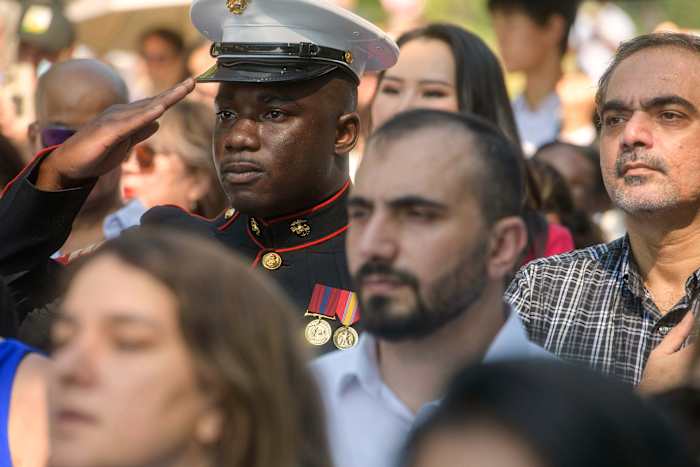
The people who were about to become United States citizens sat in folding chairs on George Washington's lawn at Mount Vernon on Saturday, 250 years after the Declaration of Independence.
The sun beat down and the well-dressed crowd was a flutter of paddle fans stamped with American flags. Their families clung to the shade of the trees on either side, where one woman had two American flags stuck through her ponytail.
“Well, good morning, everybody,” said Anne Neal Petri, the regent of the Mount Vernon Ladies' Association.
“Good morning!” an excited crowd returned.
“And Happy Birthday, United States of America!” exclaimed Petri.
There were 150 people from 50 globe-spanning countries sitting in front of the small stage as they prepared to be sworn in as U.S. citizens on the July Fourth holiday and America's 250th birthday. Among them was U.S. Marine Sgt. Diakaria Sangare from Guinea, who attended in his pressed Dress Blue uniform with three medals pinned to his left breast.
Sangare had served two deployments, and, like all assembled, had gone through the long citizenship process: The test, interviews, green cards and biometrics. Others in the crowd, it was said, came from countries bathed in violence. Some fled persecution.
After a speech about Washington, the crowd was asked to rise for the national anthem.
They did. Their hats came off and their hands covered their hearts. The paddle fans calmed.
The singer belted the words: “And the rocket’s red glare, the bombs bursting in air, gave proof through the night that our flag was still there” — as Sangare held his right hand in a rigid salute, his face sober.
As the song concluded, the soon-to-be citizens clapped and returned to their seats, while another speaker asked them to stand and remain standing when their country was called.
“Albania.”
A woman in the front row with long black hair rose with a broad grin, a small U.S. flag in her hand.
“Bangladesh.”
A man in a black shirt stood. The Albanian woman, looking back, beamed at him.
It went on for 50 countries, through China and El Salvador and Iraq and Mongolia, as people stood, sometimes smiling, sometimes sedate.
At “Morocco,” a man in the back thrusts his fists in the air in support. A young boy looked up at him and then did the same, a little flag in his fist.
Then the crowd, with hands raised, recited an Oath of Allegiance, not so different from the oath Washington signed in 1778.
“Congratulations,” they were told. “You just became U.S. citizens.”
There was applause and laughter, then the Pledge of Allegiance. Sangare, his hand now over his heart, closed his eyes for a moment.
Nearby stood a tulip poplar tree, planted at Washington’s direction 250 years ago, that had lived through America's history.
The next speaker, historian Douglas Bradburn, pointed it out in his speech before the day's special guest.
“All the stories that are part of you, now become American stories,” said Bradburn. “When people ask me what are American people like, I now can talk about you, and your stories.”
“The second side of that is that, now, all America’s stories, and our history, are your stories. The father of your country is George Washington.”
The first president, it turned out, was the next speaker.
As he was introduced, the re-enactor stood by a massive draped American flag, a sword scabbard on his hip. Then he donned the stage, doffed his cap to the audience, and began to speak.
“Today the name of ‘American’ belongs to you every bit as much as it does to me,” he said. He spoke to their arduous journeys to this point and their histories, now merged with America.
“So, my fellow Americans, to you, I say simply: ‘Welcome home’.”
Afterward, Sangare, the U.S. Marine, posed for a portrait, hands clasped in front of him, holding the American flag paddle fan, his Marine cap slightly askew.
“I just became a United States citizen,” he said, his emotions pushing out in an earnest smile.
____ Bedayn reported from Austin, Texas.