
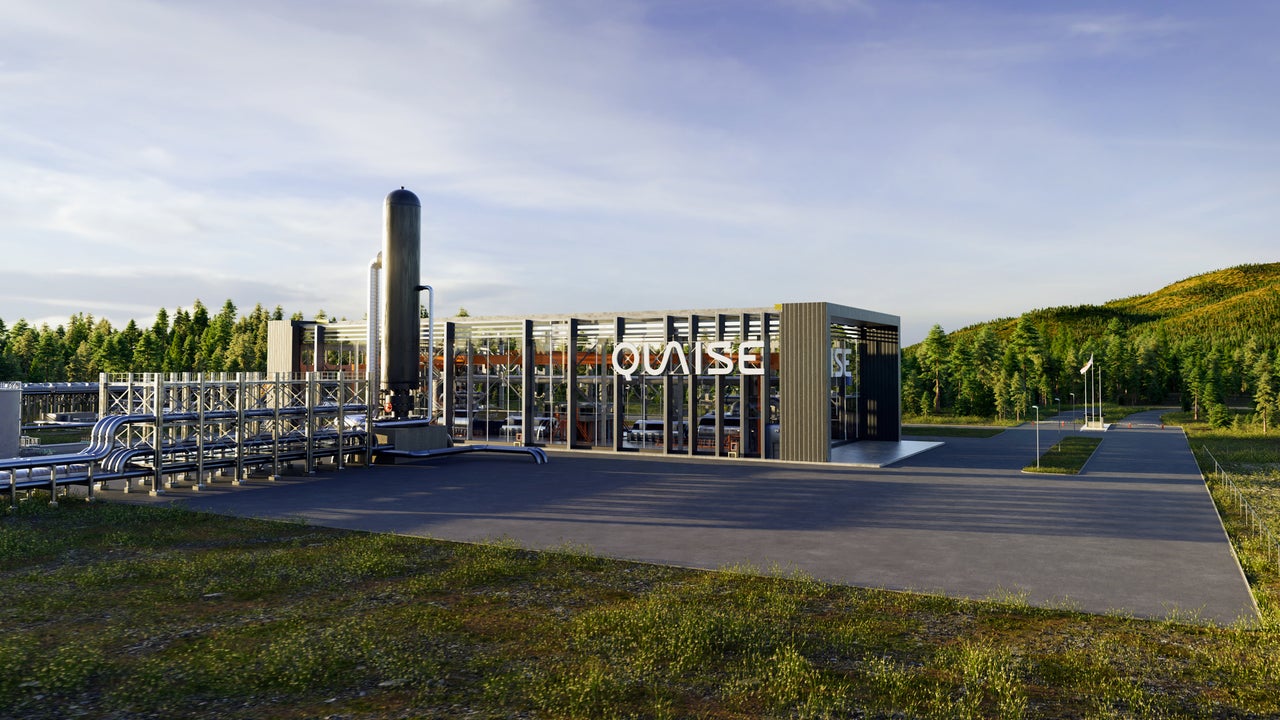
Hidden in a forest south of Bend, Oregon, a first-of-its-kind clean energy project is starting to take shape. Called Project Obsidian, the “superhot” geothermal power plant will deliver 24/7 electricity—and could soon compete on cost with fossil fuels as it pioneers new drilling technology.
“Our goal is to be competitive, if not cheaper, than existing sources of baseload power today,” says Matthew Houde, cofounder and chief of staff at Quaise Energy, the startup developing the project, which is beginning to drill its first well now. The Houston-based company recently raised $134 million in a Series B round of funding to build Project Obsidian.
The startup is one of several working on new approaches to geothermal energy, which in the past was feasible only in places with very specific geological conditions. In Iceland, for example, geothermal energy supplies almost all of the country’s heat and nearly a third of its electricity because hot magma is close to the surface underground and heats up reservoirs of water that power plants can tap into.
Relatively few locations share similar geology. In the U.S., most geothermal growth has happened in Nevada. “You can find those conditions in California, Idaho, Utah, a handful of states in the Western U.S.,” Houde says. “But I think what the industry can agree on is a lot of the low-hanging fruit on those conventional reservoirs has already been tapped, especially in the U.S.”
Quaise’s solution is making it easier to drill much deeper underground, where rocks are consistently hot no matter where you are—and can produce 5 to 10 times more energy than a typical geothermal well today.
The tech spun out of research at the Massachusetts Institute of Technology. Paul Woskov, a scientist studying fusion energy, learned that one of the challenges facing geothermal was the difficulty of drilling deep into hot rock.
“As you go deeper and hotter, it gets exponentially more expensive,” Houde says. Drill bits quickly wear out, and it’s costly and time-consuming to keep replacing them.
From his work on fusion, Woskov knew about gyrotrons, devices that can heat up plasma to ultrahot temperatures using millimeter-wave technology.
Houde explains: “Paul’s epiphany was realizing that if we can use the same energy to heat plasmas to millions of degrees Celsius to get fusion, why not use that for heating and drilling through rock at a much more modest temperature?”
In the lab, the MIT team demonstrated that it worked, vaporizing rock to make holes a few inches deep. Quaise, which launched in 2018, spent years building up its own lab. But between the summers of 2024 and 2025, it went from drilling a few feet in the lab to drilling 100 meters underground at a quarry in Texas.
In Oregon, the project will begin first with conventional drilling. The site is next to the Newberry Volcano, and the unusual geology means it’s possible to reach hot temperatures at relatively shallow depths. The first reservoirs will be around 300 degrees Celsius (572 degrees Fahrenheit), still the hottest of their kind, even before the company starts using its new tech.
The company is about to drill its first confirmation well—characterizing the rock underground—and then will drill additional wells with existing equipment. That will give it a couple of years to continue developing its new technology with the ability to drill far deeper, eventually as much as 12.9 miles underground.
The next phase at the Oregon site will use a combination of technology, starting with conventional drilling for the first 3 kilometers and switching to the new technology to go as much as 2 kilometers farther.
Like Fervo Energy, a competitor, it also borrows drilling techniques from the oil and gas industry to drill horizontally, connecting wells so that water can be pumped through them in a closed loop. (Quaise works to minimize water use, and notes that it can utilize water that isn’t potable for drinking; the amount needed is comparable to what a farm might use to irrigate 50 to 100 acres of crops.)
The first phase of the project will be 50 megawatts, followed by another 200 at greater depth, reaching temperatures as high as 850 degrees Fahrenheit. At that stage, it could become competitive with other types of baseload power, Houde says. A not-yet-announced hyperscaler customer has already signed up to buy power from the first phase of the plant.
If it can successfully prove the technology’s potential, Quaise Energy could scale up quickly. “The promise of [enhanced geothermal] is you can take that commercial design and copy-paste it for expanding the well field to meet your production target,” Houde explains.
Each project will still require securing land, water, and permits to connect to the electric grid. But as electricity demand keeps surging, it could be a way to supply it without a corresponding surge in emissions.