
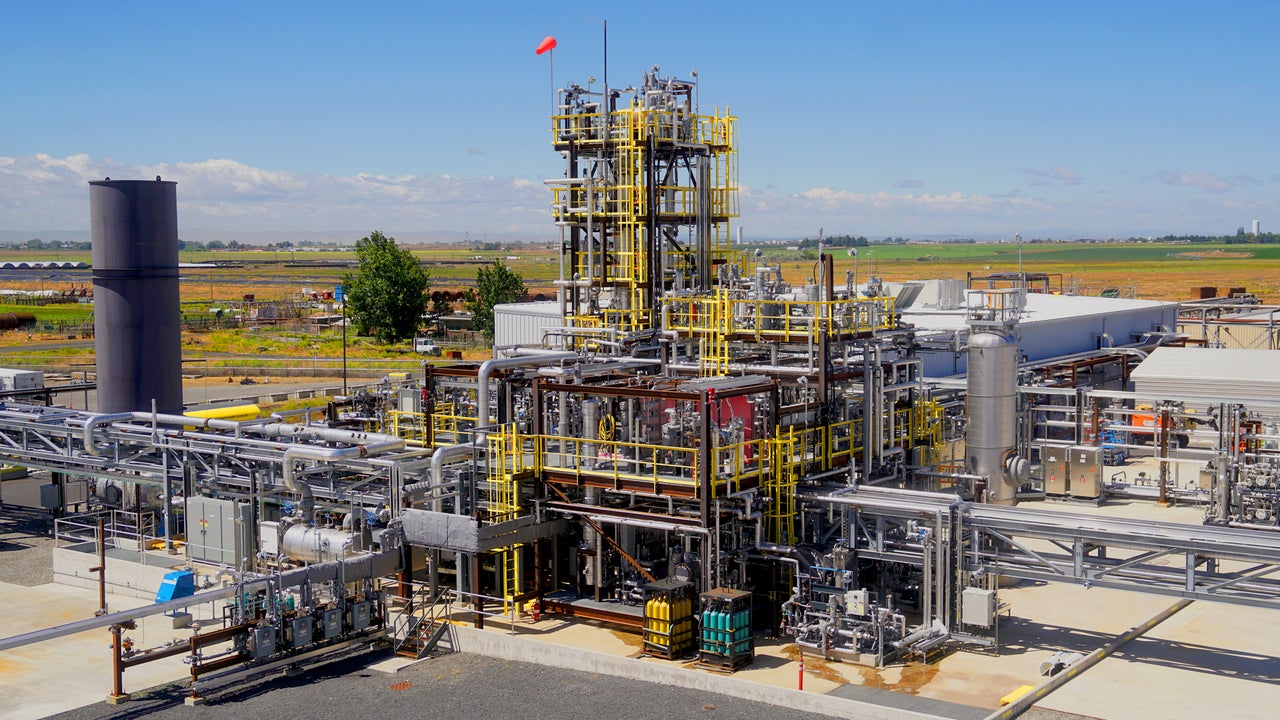
At a sprawling new plant near farm fields in Washington State, CO2 is now being turned into jet fuel—and passenger flights will likely begin using it later this month.
The facility, called AirPlant One, officially opened today. It belongs to Twelve, a startup that has spent the last decade developing the tech to convert CO2 into useful products. Now that’s beginning to happen at commercial scale.
“You have a CO2 molecule going in at one end of the plant, and it is getting transformed into on-spec jet fuel on the other side,” says CEO and cofounder Nicolas Flanders.
A large tank of CO2, using pollution captured at an ethanol plant, is fed into a system where it’s converted into syngas, running on renewable electricity. Then that’s transformed into synthetic crude and refined into a product that the company brands as E-Jet sustainable aviation fuel.
It’s chemically identical to conventional jet fuel. Right now, though, planes have to use a blend of the new fuel and conventional fuel. That’s because petroleum-based fuel includes aromatics, a type of molecule that dictated the design of rubber seals in aircraft fuel systems. “A perfect kerosene, like we’re making, doesn’t include some of those impurities like aromatics,” Flanders says. New aircraft have updated seals that will make it possible to run on 100% CO2-based fuel. (The FAA currently allows up to a 50% blend.) Otherwise, it’s a drop-in replacement and nothing on current planes needs to change.
The new fuel is designed to have up to 90% lower emissions than current jet fuel. As the facility ramps up production now, emissions are temporarily higher, and Twelve is tweaking some steps in the process. But the first batches of fuel are already being delivered to airlines for commercial use. When Twelve hits its targets for carbon intensity, Alaska Airlines—an investor and key partner—will begin using it in its own flights.
Alaska Airlines already buys some sustainable aviation fuel (or “SAF”) made from waste oil and fats, such as used cooking oil. But there are limits on how much can be made that way. “At a certain point, you run out of those fats, oils and greases,” says Ryan Spies, Alaska’s sustainability director. The company wanted to diversify its options.
Globally, the aviation industry uses around 100 million gallons of fuel in a year. Only a tiny fraction—around 0.3%—is sustainable aviation fuel now. But “there’s way more CO2 being emitted each year than we would need to make all of the jet fuel that the world consumes,” says Flanders.
As the new plant continues scaling up, it’s designed to produce 55,000 gallons of fuel per year. Twelve is also producing a CO2-based version of naptha, hydrocarbons used to make plastic and everything from car parts to laundry detergent. The next plant will be much larger, producing tens of millions of gallons of fuel a year. A handful of other companies are also working in the space, including Infinium, which is also beginning to produce jet fuel made from CO2 at a plant in Texas.
At the moment, unsurprisingly, it’s more expensive than conventional jet fuel. (Twelve declined to share cost.) Alaska Airlines partnered with Microsoft to help offset some of the early cost; Microsoft is buying Scope 3 carbon credits from the project. But in the long term, as Twelve gains economies of scale and more efficiency, Flanders argues that the marginal cost of producing the fuel will drop to the marginal cost of producing renewable energy.
The cost can also be predictable, unlike jet fuel now. “We can make a fuel with domestic resources that is completely independent of international oil markets and actually has an underlying contractual structure where we can lock in our pricing for 10-plus years, because we can get a long term contract for the electricity and the CO2,” Flanders says. “That creates a new level of predictability for customers than they can access with conventional fuel.”
The tiny volumes available now won’t help with the current volatility because of the war in Iran, which has forced jet fuel prices so high that some airlines are cutting back on flights. But it points to the potential. “I think it certainly frames the discussion beyond just the environmental benefits,” says Alaska’s Spies. “Environmental benefits are where we started. I don’t know that that will be the carrying message going forward. You’re going to see arguments around resiliency, around local supply, around assurance of supply. I think all of those things make a really great case for a product that already had a pretty good case.”