
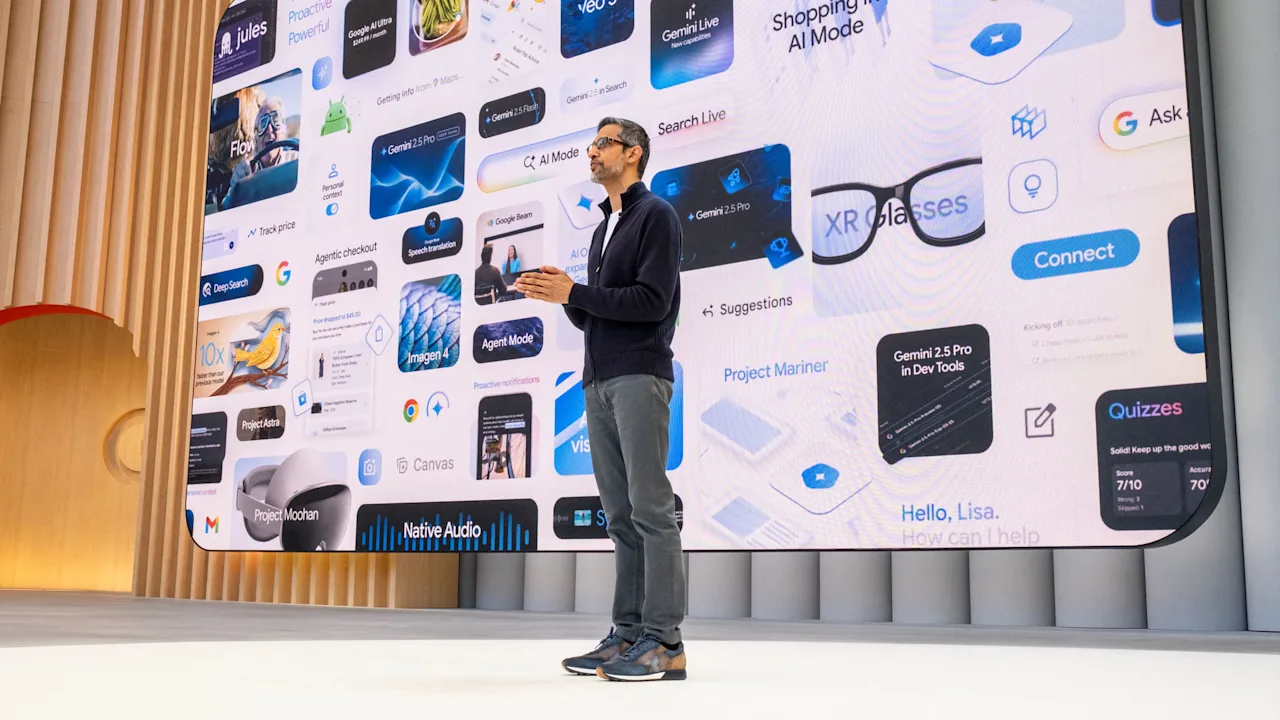
The release of Google’s latest AI models this week at Google I/O was yet another example of the direction of travel for the generative AI revolution. Facing a user base that is increasingly burning more tokens under basic subscriptions or API access, AI companies are starting to hike prices and throttle usage.
In response to those cost pressures, consumers are beginning to cut their cloth accordingly. And while frontier AI providers are releasing ever more powerful models into the world, smaller companies are advancing, too. Often based in China, these are frequently accused of copying the innovations of U.S. models through techniques like distillation, or reverse engineering the way artificial intelligence models work by probing them and inferring their answers.
What it means is that these slightly less powerful AI models are, despite lagging behind the bleeding edge, still plenty powerful for most people. The 2026 Stanford University AI Index found that AI models’ performance on the SWE-bench Verified coding benchmark surged from 60% to nearly 100% of the human baseline in the last year, while the highest-quality models gained 30 percentage points on the highly difficult Humanity’s Last Exam benchmark. At the same time, Stanford charted a shrinking gap between U.S. models and their Chinese competitors, which are often offered at a fraction of the price, or entirely free through locally hosted versions.
The result is that we’re entering the “good enough” era of AI models, where the needs of all but AI’s power users could be capably handled with something that costs less than giving the likes of Anthropic or OpenAI $200 a month.
“Not every task requires maximum capability,” says Azeem Azhar, founder of the Exponential View newsletter, and a user of both the frontier models put out by the biggest AI labs and smaller, cheaper alternatives. “You don’t need Nobel scientist intelligence to appeal a parking ticket.”
Not everyone agrees that the gap between the cutting edge and the “good enough” models is surmountable right now, in large part because of the shift toward more agentic uses of AI. Max Weinbach, an analyst at Creative Strategies, argues that while smaller models can handle narrow or basic tasks, they still “struggle to understand everything” in the way increasingly autonomous AI agents are expected to. Models like Gemma 4 27/31B and Qwen3.6, he says, are solid for lightweight use cases, but tend to break down on more demanding tasks like vibe coding, even when paired with tools like Hermes or OpenClaw, because “the model just isn’t capable.”
The idea that you could entirely live and work on locally hosted or lower-capacity models still seems slightly beyond the reach of most people. There are times when you need the extra oomph that only the models underpinning the likes of ChatGPT or Claude can provide. But the gap does appear to be closing. And for most tasks, the extra capabilities that the leading, more expensive models provide aren’t necessarily needed, something Azhar compares to getting an 8K TV when you’re barely likely to perceive the difference from a 4K one.
For some, though, the idea that there’s only an imperceptible gap between the likes of OpenAI and Anthropic’s models and those of the cheaper Chinese labs, or locally hosted models, is an exaggeration. Weinbach points out that it may cost practically nothing to run a model six times in order to get the right response, with five attempts glitching out or producing the wrong answer. “But almost every user is willing to pay $20 a month to nearly guarantee a correct response the first time,” he says.
What “good enough” actually means may ultimately shape consumer behavior more than model performance. Weinbach argues that people rarely choose products they see as merely adequate for tools they use every day, and that settling for good enough often becomes “a regretted decision” that eventually pushes users toward more premium options.
And even if people do, if there’s one thing that widespread AI adoption over the past three-and-a-half years has taught us, it’s that for those who buy into the promise of AI, once you start using it, you discover new possibilities and use cases for it.
“The cheap, ubiquitous, good-enough capability creates new users, new habits, new expectations,” says Exponential View‘s Azhar. “Those habits eventually generate demand for capabilities that only the frontier can satisfy.”