
Tire shops are not exactly known for cutting-edge technology. You pull in, hand over your keys and hope the wait does not take over your day. Automated Tire, Inc. wants to change that.
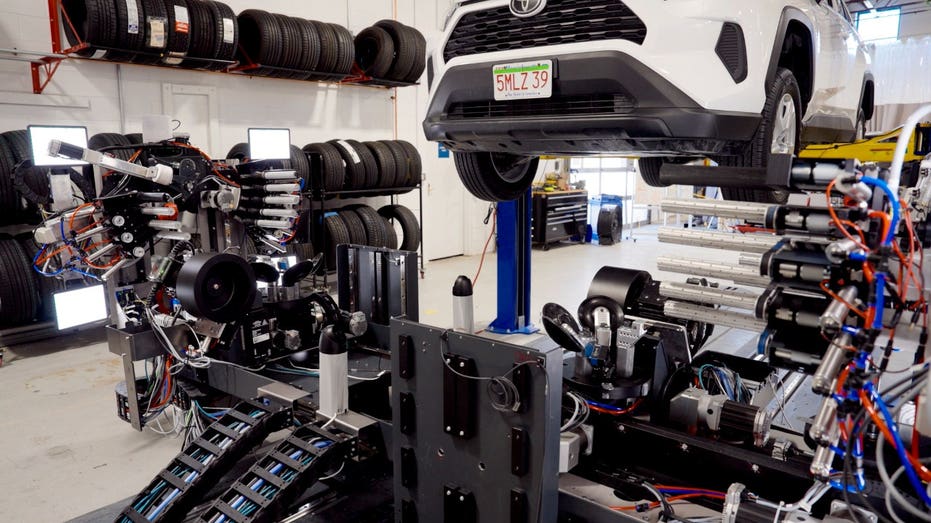
The Boston-based robotics company has unveiled SmartBay, an AI-powered robotic tire change platform built for dealerships, tire shops and service centers. The system handles tire changes, wheel balancing and vehicle inspections with minimal human intervention.
The timing could be good for repair shops. Many are struggling to find technicians, while EVs are putting more demand on tire service because they can wear through tires faster. SmartBay is ATI's answer to a service-bay problem that has been building for years.
SmartBay is a robotic service-bay system that uses physical AI, computer vision and machine learning to perform tire work in real time. Instead of relying on fixed routines, the system adapts to each vehicle.
Andy Chalofsky, CEO of Automated Tire, Inc., describes it as "the next generation of the automotive service bay," a robotic-first system built to automate routine, physically demanding work that has traditionally required skilled service-bay personnel.
"Rather than relying on a technician to manually remove the wheel, dismount the tire, balance it on traditional equipment, and reinstall everything, SmartBay performs the tire change and wheel balance itself with only light-touch oversight from an operator," Chalofsky said.
SmartBay is designed to take on the tough tire work technicians usually do by hand. A worker still keeps an eye on the process, but the robot handles most of the lifting, tire changing and balancing.
Here is the part that may surprise you the most. SmartBay leaves the wheel on the car.
"SmartBay is the first patented system in the world that changes tires without removing the wheel from the vehicle. The car is lifted just as it would be on a conventional lift, but instead of taking off the lug nuts, disturbing the tire pressure monitoring system, and pulling the wheel, SmartBay dismounts the tire directly from the rim while the rim stays on the car," Chalofsky said.
After the new tire is mounted, SmartBay performs ATI's trademarked Real Force Balance. Chalofsky says the technology balances "the entire wheel-end assembly, including all of the rotating components in the wheel well," instead of only balancing the tire by itself. He says the result is "the most complete and accurate balance available on the market today."
Tire appointments can go sideways fast, especially when a shop is short-staffed or one job takes longer than expected.
"Anyone who has spent time in a tire shop knows how quickly a busy day can fall apart: a technician calls in sick, the first car of the morning takes longer than expected, and the appointments stacked behind it back up the entire schedule," Chalofsky said.
That is the bottleneck SmartBay is designed to ease. ATI says one technician can manage up to three SmartBay-equipped service bays at once. ATI also designed SmartBay to fit inside a standard 12-foot service bay, so shops do not need oversized lanes or major infrastructure changes.
The company says its initial machines are targeting a 45-minute door-to-door tire change for four tires, mounted and balanced. As the technology learns more, that time could be reduced to 30 minutes.
SmartBay has to deal with whatever rolls into the service bay that day. "Every vehicle that comes into a service bay is different," Chalofsky said. "Even within a single model line, those combinations multiply quickly."
Road grime adds another layer of difficulty. Vehicles may arrive covered in mud, snow, road salt, brake dust or rain, and the system still has to identify what it is working on safely.
Chalofsky says SmartBay handles all of this with "a self-learning AI layer that adapts in real time to hundreds of data points per vehicle."
That approach takes the kind of judgment technicians build over years and turns it into a repeatable system that can keep learning over time.
Speed is a big part of what ATI says SmartBay can bring to an auto service business. Chalofsky says the system creates consistency because it can repeat the same process with less variation from one vehicle to the next.
"A single technician can run two or three SmartBays in parallel, processing roughly 24 tires an hour compared to about four tires in 75 minutes today", Chalofsky said.
That could help keep the day from getting backed up when appointments start stacking. For customers, it could mean less time waiting around for updates. Chalofsky says the result can be "more billable volume" and "more predictable scheduling" for high-volume service centers.
Tires may not sound like the most exciting place to start, but they are one of the most common reasons people visit service centers. They also make a strong case for automation because the work is frequent, physically demanding and hard to staff.
"Tire changes and wheel balancing check nearly every box for a first product. It's one of the most frequent reasons a vehicle comes into a service bay, it's a high-dollar transaction, the work is physically arduous and exactly the kind of task a robotic-first platform is well suited to handle, and the labor shortage is most acute precisely in this part of the workforce," Chalofsky said.
He points to EV growth, retiring technicians and broad demand across dealerships, aftermarket shops and fleets. ATI also has a personal connection to the problem. Chalofsky is a fourth-generation tire industry entrepreneur and previously founded several tire businesses, including SimpleTire.
That background gives ATI firsthand knowledge of how tire shops actually operate. Rather than chasing a flashy robotics use case, the company is applying tire-industry experience to a long-running bottleneck.
If you own a gas car, hybrid or EV, this kind of technology could make a tire appointment feel like less of a waiting game. A robotic tire system could help shops move cars through faster when appointments start piling up. It could also make balancing more consistent, which may help your car ride more smoothly after service.
EV owners may feel the impact sooner. Heavier electric vehicles can wear through tires faster, and replacement costs can add up quickly. If shops can handle more tire work without longer waits, EV maintenance could become a little less frustrating.
SmartBay could also change the job for technicians. Instead of spending as much time on the most physically demanding tire work, they could shift more toward oversight and higher-skill repairs.
For service centers, the payoff is steadier operations. When one technician can oversee multiple bays, a busy day may be less likely to turn into a long backup.
Think your devices and data are truly protected? Take this quick quiz to see where your digital habits stand. From passwords to Wi-Fi settings, you’ll get a personalized breakdown of what you’re doing right and what needs improvement. Take my Quiz here: Cyberguy.com
SmartBay is one of those things that makes you wonder why tire service has not changed more by now. Cars have become far more advanced, but many tire shops still rely on the same tough manual process drivers have dealt with for years. ATI is betting that physical AI can help the service bay catch up with the vehicles coming into it. The real test will be what happens on a packed Saturday morning when every bay is full, and customers are watching the clock. Robots can look impressive in a demo. The real question is whether they can hold up in busy service bays and make tire appointments less of a headache for drivers.
Would you trust an AI robot to change and balance your tires if it meant a faster visit and a smoother ride? Let us know by writing to us at Cyberguy.com
Copyright 2026 CyberGuy.com. All rights reserved.