
Plus, you'll get instant access to my Ultimate Scam Survival Guide free when you join.
Airports are under pressure from two directions at once. Passenger numbers keep rising, while the number of available workers is shrinking.
Japan is feeling that squeeze more than most. Tourism continues to surge, yet the working-age population is declining. That creates a gap that is hard to fill with traditional hiring alone. Japan Airlines employs thousands of ground crew workers, highlighting the scale of the challenge.
Instead of redesigning airport systems from scratch, companies are exploring humanoid robots that can fit into existing workflows. A robot shaped like a person can move through the same spaces, use the same equipment and work alongside human crews without major changes.
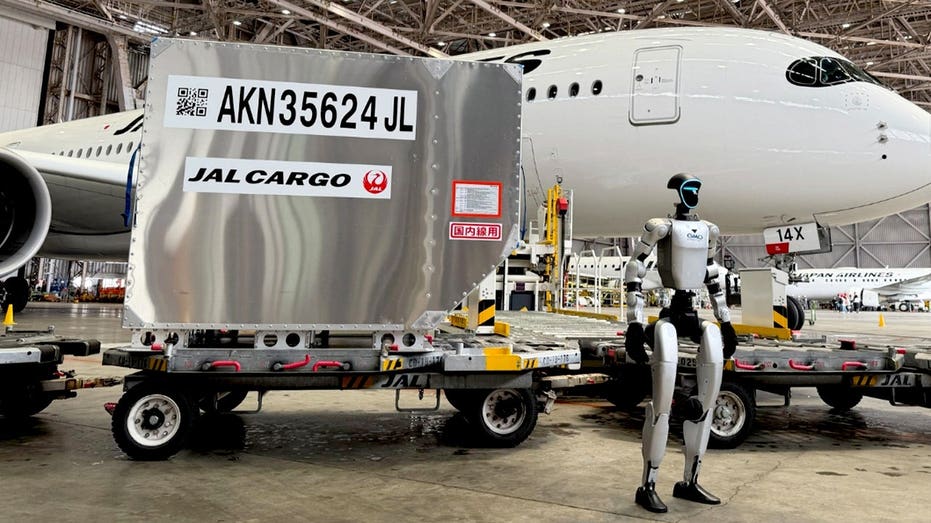
The machines being tested come from Unitree Robotics. One model, known as the G1, is compact enough to move through tight spaces yet capable of lifting and pushing cargo. It stands a little over four feet tall and weighs about 77 pounds. The design folds for storage, which matters in crowded airport environments.
What makes it useful isn’t size alone. The robot uses sensors like 3D LiDAR and depth cameras to understand its surroundings. It can recognize objects, adjust its movement and even respond to voice input.
During a recent demonstration, the robot pushed cargo onto a conveyor belt and signaled to a nearby worker. That interaction may sound small, yet it shows how machines and humans can coordinate in real time. These early demonstrations are designed to evaluate how robots can safely assist in real airport conditions rather than operate independently.
Before a robot ever touches a suitcase, it spends time in a virtual world. Engineers create a digital version of the machine and train it using simulations. Nvidia provides tools like Isaac Simulator, where robots practice tasks again and again without real-world risk.
Motion capture data helps the robot copy human movement. Then reinforcement learning refines those actions through repetition. Once the system performs reliably in simulation, the behavior transfers to the physical robot. This process, often called Sim2Real, helps reduce mistakes when the robot enters a busy environment like an airport.
Even as automation expands, airlines are drawing clear boundaries. Robots are expected to take on repetitive, physically demanding tasks. That includes moving baggage, loading cargo and assisting with equipment.
In the future, they could also support a wider range of tasks, such as cabin cleaning or operating certain types of ground support equipment. GMO AI & Robotics also sees workers shifting toward supervision, decision-making and robot management as the technology matures.
Still, critical responsibilities remain with people. Airports are busy, unpredictable environments where workers, aircraft and ground equipment operate close together. For now, the goal is to learn where humanoid robots can safely help crews while reducing physical strain.
Attempts to automate airport work are not new. Traditional robots have struggled in unpredictable settings where objects move, people walk through work zones and conditions change quickly. Humanoid robots offer a different approach. Their human-like form lets them adapt without requiring major infrastructure changes.
Japan's trial will run through 2028, giving airlines time to evaluate performance and refine how these machines fit into daily operations. The rollout is expected to follow a phased approach, starting with observation and testing before expanding into more practical use cases. If the results hold up, similar systems could appear in airports around the world.
If you fly in the U.S., you likely will not see robots on the tarmac tomorrow. Still, what happens in Japan could signal where airports everywhere are headed. If these trials work, similar systems could show up at major U.S. airports. That could mean faster baggage handling and fewer delays during busy travel periods.
It could also change working conditions for airport crews. Robots may take on the heaviest lifting, which could reduce injuries and make jobs more sustainable over time. At the same time, new questions will follow. Airlines will need to prove these systems are safe, reliable and ready for real-world pressure before expanding them across busy U.S. airports.
Think your devices and data are truly protected? Take this quick quiz to see where your digital habits stand. From passwords to Wi-Fi settings, you’ll get a personalized breakdown of what you’re doing right and what needs improvement. Take my Quiz here: CyberGuy.com.
Robots moving baggage on an airport tarmac may take a minute to get used to. Still, it makes more sense once you understand the reason behind the trial. Airports are getting busier, and ground crews are already doing tough physical work under real pressure. If these robots can safely take on some of the heaviest stuff, they could give workers more support and help flights move more smoothly. The real test will be how well people and machines work together when the airport is busy and every minute matters.
If robots start handling your luggage, would you trust them to get it right every time? Let us know by writing to us at CyberGuy.com.
Copyright 2026 CyberGuy.com. All rights reserved.