
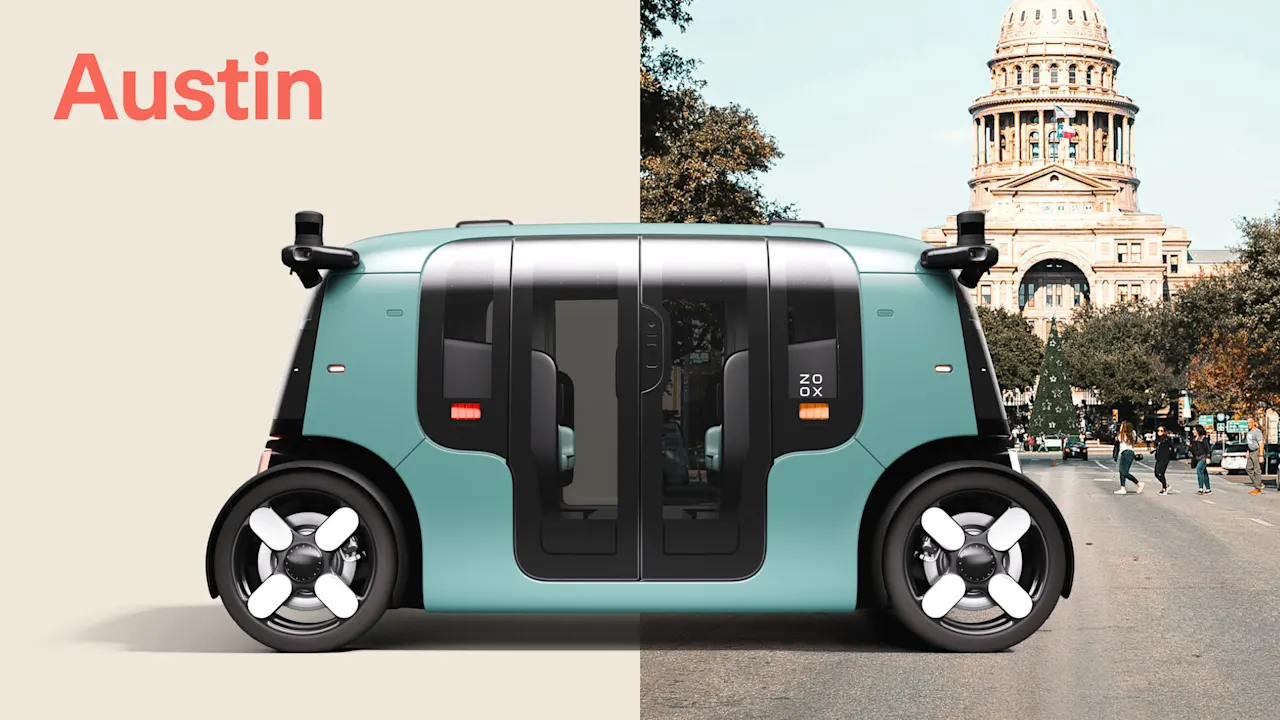
Zoox, the Amazon-owned autonomous driving company known for its whimsically shaped robotaxis, is expanding to new locations.
The company on March 24 announced plans to begin operations in Austin and Miami later this year, while expanding its existing footprint in Las Vegas and San Francisco.
In Las Vegas, riders can now access additional locations along the Strip, with service expected to reach the Sphere, T-Mobile Arena, and Harry Reid International Airport. In San Francisco, service will expand this spring to neighborhoods including the Marina, North Beach, Chinatown, and Pacific Heights, as well as along the Embarcadero—more than quadrupling Zoox’s current footprint in the city.
The expansion comes with technical upgrades, including machine learning model updates aimed at smoother rides and more accurate arrival time estimates. Regular software improvements have helped to enable service in new areas as the vehicles become more capable, says cofounder and CTO Jesse Levinson.
“For example, in San Francisco, our new geofence includes steeper hills, more dense traffic, places where you have to make more assertive lane changes,” he says. The cars have also gained the ability to operate in fog and rain, which will help in the push into Miami.
For now, Zoox’s distinctive electric vehicles—featuring inward-facing seats and no driver’s seat or steering wheel—operate under a regulatory exemption from the National Highway Traffic Safety Administration that allows them to run free rides. The company is still applying for a separate exemption that would allow it to charge for service, Levinson says.
Its fleet remains relatively small, growing from about 75 to roughly 100 prototype vehicles as part of the expansion. That is expected to change once Zoox begins mass-manufacturing the production version of its vehicles at its plant in Hayward, California. The company hopes to start later this year and eventually produce three vehicles per hour, enabling a significant increase in fleet size. Alphabet-owned Waymo reportedly has at least 2,500 automated vehicles in service.
“A bit later in the year, when we start producing our production vehicles, you’ll start to see significant expansion in the size of our fleet in the cities we operate,” Levinson says.
Anyone can currently request a free ride via the Zoox app in Las Vegas, though wait times can be long due to limited vehicle availability and the lack of fares. In San Francisco, riders must join a waitlist, which already includes several hundred-thousand people.
In addition to its custom-built vehicles, Zoox operates a testing fleet of retrofitted SUVs staffed with human safety drivers. These vehicles map and test new cities ahead of launching automated taxi service. In early March, the company announced test deployments in Dallas and Phoenix, joining markets including Los Angeles, Seattle, Atlanta, and Washington, D.C. The test fleet has been operating in Austin and Miami since mid-2024, the company says.
Zoox also announced a partnership with Uber that would allow Uber customers in Las Vegas and Los Angeles to be matched with Zoox vehicles. The rollout is expected to begin this summer in Las Vegas—likely after the company is cleared to charge for rides, Levinson says—and in mid-2027 in Los Angeles. Riders will still be able to book directly through the Zoox app, but the partnership gives Zoox access to Uber’s large customer base, including those who may not want to download another ride-hailing app.
“We will continue to offer the Zoox app in all of our cities,” Levinson says. “But we have started to explore what a partnership with Uber could look like, starting in those two cities, and I think we’ll both learn a lot from each other.”
Zoox is also rolling out new features aimed at improving convenience and comfort. A “Find My Zoox” option will allow passengers to customize lighting and trigger blinking lights on their vehicle, making it easier to spot in crowded areas. Riders will also be able to pair their devices with in-vehicle Bluetooth audio and automatically reconnect on future trips, Levinson says. The vehicles already support music playback from prebuilt playlists.
Competition in the ride-hailing market appears poised to heat up, with Waymo also expanding to new markets, Elon Musk touting plans for automated Tesla taxis, and Uber recently announcing a separate deal to invest up to $1.25 billion in electric vehicle maker Rivian as part of its robotaxi plan. But Levinson says he imagines Zoox’s lead time in creating custom-built autonomous cars will give it an edge on rival operators.
Still, Levinson argues that Zoox’s early focus on custom-built autonomous vehicles could provide an advantage.
“As other companies might try to come out with their first purpose-built robotaxi, we might be on our second or third iteration,” he says. “Hopefully, those learnings will continue to allow us to have a meaningful benefit for our customers.”