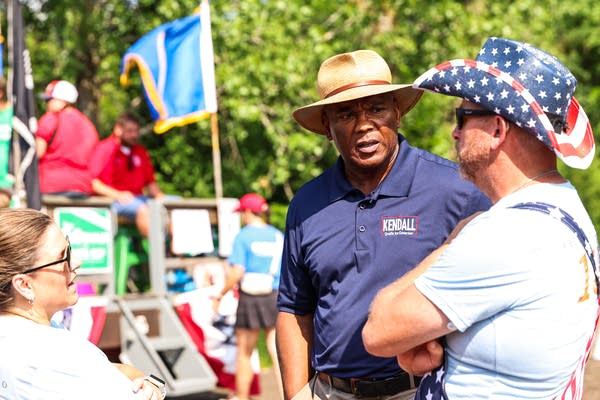
The slate of endorsed Republican candidates lined up onstage in a bowling alley banquet hall when a voter among the dozens in the room posed a question: How can you win?
This year, that might apply to the primary election more than anything.
The Minnesota Republican Party’s endorsement is typically the ticket to the November ballot. But the endorsed candidates for governor and U.S. Senate in particular face stiff challenges this year that could derail that straight shot.
In May, businessman Kendall Qualls and former Navy SEAL Adam Schwarze prevailed over competitors for the GOP endorsements for governor and U.S. senator, respectively. But opponents who are more widely known and better funded remained in the race for the party’s nomination. Early voting is underway.
If either Qualls, Schwarze or both lose, it would reverse a three-decade trend for Minnesota Republicans that the endorsement is golden. No candidate for Senate or governor has reached the November ballot without the party’s endorsement since the mid-1990s.
The stakes go beyond this election. If future candidates decide the endorsement isn’t worth it, they might head straight to a primary and focus their messages beyond the fairly narrow band of voters who have held immense power for decades.
Qualls himself bowed to the endorsement four years ago, stepping aside when Scott Jensen won at the convention.
He figured it would go the same way this time.
“We've had some hiccups with the state party,” Qualls said.
That started just days after his crowning moment. The GOP chair permitted candidates who lost in the governor’s race to reverse pledges to abide by it, bowing to concerns that glitchy voting devices weakened confidence in the result.
Qualls, who invested heavily in the convention fight, was furious but the race would go on.
His hopes still rest in history, where prior candidate efforts to overcome the endorsed candidate came up short.
“We had a two-term governor, Tim Pawlenty, with much higher name recognition, a lot more money, that still couldn't break through the endorsement process, and we're working hard to make sure that doesn't happen in our case,” he said.
House Speaker Lisa Demuth is among those who powered forward. So far, she’s been the only one to air TV ads and a group pushing her candidacy has, too. She’s snagged some key endorsements as well, including those of pro-gun groups.
MyPillow CEO Mike Lindell, also skeptical of the convention’s voting technology, pressed on, too. His big get: President Donald Trump’s backing.
The state GOP chair, Alex Plechash, reacted to the president’s endorsement by describing Lindell’s flaws as a candidate. His statement didn’t mention Qualls as the party’s official candidate; Qualls took note of that.
For Qualls, the endorsement — that usual slingshot to a primary win — brought little momentum.
“It's been a jump. It hasn't been a high dive springboard, if you will,” Qualls said. “Obviously, we have Lisa Demuth that didn't honor her commitment to abide by the endorsement, so that's been an issue.”
He said he’s hopeful his campaign can find its stride with just weeks left ahead of the primary.
Qualls is a former healthcare company executive who later founded a conservative issues think tank. He’s run before — for Congress in 2020 and governor in 2022 — and come up short. Qualls has made connections through those past campaigns but knows he needs to sell more voters on his candidacy.
He hoped to cut through on a debate stage against Demuth and Lindell. But none materialized.
Instead, Qualls has spent recent weeks responding to allegations that his nonprofit engaged in prior campaign work, which is barred under federal law. He also had to respond to stories about his running mate, Brian Nicholson, being accused of financial misconduct and being present at the U.S. Capitol when rioters stormed it on Jan. 6, 2021.
“We've obviously got challenges,” Qualls said last week.
Schwarze, a former Navy SEAL, faces a similar challenge in the Senate race. He’s in a crowded primary against former sports broadcaster Michele Tafoya, former pro basketball player Royce White and others.
“There's been a lot of chaos this election cycle across the country, really, but certainly within Minnesota, we're not rowing in the same direction,” Schwarze said. “I think that's a little bit disappointing.”
Schwarze said while Tafoya is better known and has more money, he’s confident that his outsider message will break through. Tafoya is up on TV with ads and entered July with millions at her disposal.
Schwarze had to take out a personal loan and entered the homestretch with only a couple hundred thousand in the bank.
He’s hoping the money gap won’t matter.
“If you look at all the endorsed candidates, we are also veterans, but also political outsiders, and I think that that is what you're seeing not only for the Republican Party, but successful on both sides of the aisle,” Schwarze said. “The money and the D.C. (support) is not going to win races because Americans don't want to be told who to vote for.”
At the candidate forum, Renee Ross donned a baseball cap that lit up with an image of Trump, then with Qualls’ name. Ross said Qualls could bring in Republican voters, but some conservative independents or potentially Democrats, too.
“I think he's the candidate that can do it. He's from outside, so he's not part of the established Republican, whatever you want to call it, here in this state,” Ross said. “He's an outsider but he's also such a successful businessman, and that's basically what the governor is. You have to run a successful business to keep the state afloat.”
To the question about how endorsed candidates can win in November, Qualls said it will require Republicans coming together and supporting them.
“When we're not excited about our ticket, like Mitt Romney, we don't win,” Qualls told the crowd of GOP voters. “We fight too hard amongst ourselves, and not hard enough against the Democrats, my friends. This is what I'm trying to do. We're trying to do the bigger thing, and they're trying to undermine the value of this endorsement process.”
Voting continues through Aug. 11. Minnesota will choose its next governor 12 weeks later.