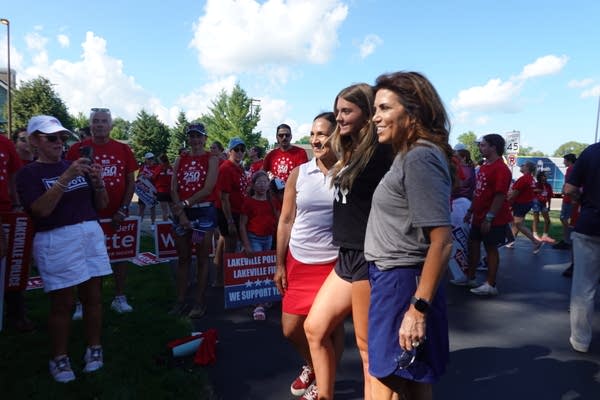
Minnesota House Speaker Lisa Demuth and former sports broadcaster Michele Tafoya each put an arm around the other and smiled wide last week as they prepared for the Pan-O-Prog parade.
Surrounded by local lawmakers and GOP candidates, they posed for photos and rallied volunteers. To an untrained eye, the duo lined up in the parade behind local candidates could come off as the Minnesota Republican Party’s official slate.
But the pair lost their party’s endorsing contests in May; Tafoya came up shy of the Senate endorsement and Demuth lost after several ballots in the governor’s race. But they’re vying to buck the recent historical precedent — and move on to the general election through Aug. 11 Republican primaries wins.
“Neither one of us is endorsed, and we're pushing hard, and we feel like we're in it to win it,” Tafoya said. “We have been crisscrossing the state, doing parades, talking to people.”
This year, Demuth and Tayofa are in the hunt. They have more money than their rivals and broad recognition. They tell primary voters they’re better equipped to break Republicans’ two-decade losing streak in statewide races than their endorsed peers — former Navy SEAL Adam Schwarze for Senate and businessman Kendall Qualls for governor.
Another contender, MyPillow CEO Mike Lindell, is also vying for the party’s nomination for governor. His cause was helped in a big way this week with a significant endorsement – from President Donald Trump.
Typically for Republicans, the endorsement is a critical path to the nomination. No candidate for Senate or governor has gotten to November without it in three decades.
In 1994, then-Gov. Arne Carlson won a primary after being bypassed at the convention. Two years later, the party deadlocked on an endorsement after 14 ballots in the 1996 Senate race, and former Sen. Rudy Boschwitz then cruised to a primary win. But in every race since, the endorsement has been golden.
With stances of most of the Republican candidates overlapping — they’re all talking about fraud, spending, taxes and election integrity — the onus is on campaigns to find other ways to appeal to GOP voters.
“They are fed up, but they are excited, and they're so enthusiastic about this campaign,” she said, pointing to fundraising numbers and other metrics that she contends prove it. “They speak volumes about all the support that we're getting from every county in the state.”
Tafoya has a wide advantage on that front. Her $2.6 million raised in the past few months was almost 10 times more than her closest GOP competitor.
Demuth likewise had a yawning money edge over the others in the Republican governor’s race, with updated reports due later this month.
Demuth said she and Tafoya are running distinct races. That is, they haven’t been intentionally adjacent in their bids for the GOP nomination. But she expects their pool of support in next month’s primary to be similar.
“When people look at who's a good candidate that can actually win and turn this state around, maybe people are looking at me for that, and probably some of the same people are looking at Michele Tafoya for that too, a very solid candidate that could win,” Demuth said.
Qualls and Schwarze landed party backing with their political outsider messaging. But Demuth says Republicans need candidates who can appeal to voters in both August and November, which requires reaching beyond the base.
“The things that we're doing now for the primary are the same things that are going to carry us through into the general. It's the same message. It's the same universe of people that just want to see our state get back on track,” Demuth said.
In Brainerd this week, Qualls was pressed by a voter about whether he was the candidate best suited to win a general election. He told dozens of local Republican voters and organizers that the best path for Republicans is to come together behind the slate of endorsed candidates.
“We have a Republican Party that's in civil war. We have a wing of the party that doesn't want the endorsement process,” Qualls said at the event for endorsed candidates. “Here's the issue about winning: We’ve got to be unified.”
He said if the party is fractured, that’s trouble. “We’ve got to excite the base,” he said. “I’ve demonstrated, I've been campaigning 11 months, I can excite the base.”
Bruce Cunningham, of Crosslake, posed the question about electability.
“The problem we've had is we've had good candidates, but they have not been electable by the middle, and that was the core of my question: Who is going to attract those middle voters that are really the ones that are going to make the decision this November?” Cunningham said in an interview.
Cunningham said he’s backing Qualls and Tafoya in the primary.
“Name recognition, I think, is the biggest thing,” Cunningham said. “Michele, because of her sports background, also has more recognition among male voters, which I unfortunately think is going to be a big factor.”
Others at the Brainerd event said Republican delegates vetted and picked their endorsed candidates for a reason and they don’t plan to depart from that convention recommendation.
“I'm probably going to vote this way because that's what we have decided as a Republican Party to endorse the candidates when they were endorsed in Duluth,” said Rose Stromberg, of Ironton.
Mary Rono, of Crosby, agreed.
“They vetted them. They made sure that they were ‘America First’ candidates and express our values,” Rono said. “So we want candidates that stand for the people.”
Schwarze, the party’s endorsed candidate for U.S. senator, argues the party isn’t well served by a drawn out contest.
“We do better when we fight together as a team on the battlefield,” Schwarze said. “We would be fighting together to take back our state if we were all rowing in the same direction. But it is kind of a unique thing about Republicans, right? We don't play team ball as well as the Democrats.”
On Aug. 11, primary voters will decide which direction that boat is headed.