
Adrian Riley has been behind bars since 1996, serving three consecutive life sentences for murders he says he didn’t commit.
Riley has nearly exhausted traditional routes to freedom. He lost on appeal and was recently denied parole by the state clemency board. The board said Riley didn’t take accountability for the crime and the clemency process is not meant for innocence claims.
Minnesota did set up a process to investigate innocence claims, creating a conviction review unit within the Minnesota attorney general’s office that started accepting applications in 2021.
For Riley, the creation of the unit was a “godsend.” Hearing it was shutting down this month mid-review of his case was a gut punch.
“I feel like I just got hit by Mike Tyson,” Riley said.
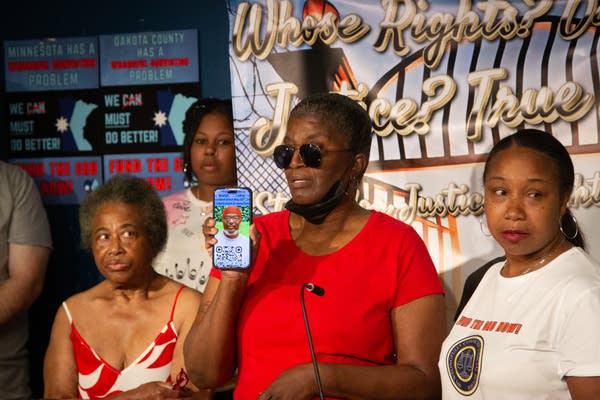
Families of incarcerated people are calling for the reopening of the unit after the attorney general’s office shut it down this month citing lack of funding. They held a press conference at the Minnesota state Capitol on Tuesday demanding the state fully fund the conviction review team.
An outside assessment described the unit’s work as efficient and “a model for how statewide conviction integrity work should be done.” For incarcerated people asserting their innocence and their families, the unit was a lifeline; but they say it needed more resources, not less. Now, with the unit’s closure, the narrow path to exoneration in Minnesota has gotten narrower.
In a statement, Democratic Attorney General Keith Ellison cited “the Trump administration’s refusal to renew federal grant funding that supported the program” as the reason for the unit’s closure.
“No system of justice is perfect, and when ours gets it wrong, we must work to put things right,” Ellison said.
“If the opportunity arises in the future — through renewed funding or other means — I would welcome the chance to resume this important work,” Ellison said. He is running for a third term this year.
The attorney general’s conviction review unit was created after serious questions about the murder conviction of Myon Burrell were raised by the media and state officials. Ultimately, according to Ianna Burrell, her brother’s case wasn’t prioritized by the unit because he was released from prison after his sentence was commuted in 2020.
Since Minnesota’s conviction review unit started receiving applications in spring 2021, more than 1,000 people have applied for consideration. After narrowing down eligible cases, the team completed five investigations and recommended relief for three men. Two were fully exonerated and one was allowed to plead guilty to a lesser charge and be released on time served.
The unit was one of a handful of statewide teams of its kind. The vast majority of conviction review units operate within local jurisdictions like the Hennepin County attorney’s office conviction integrity unit, which is now the only conviction review unit in Minnesota.
An outside review heaped praise on the attorney general’s conviction review unit. The report said that from its founding to September 2024, Minnesota’s unit completed five investigations and recommended relief for three people. A survey of six other statewide units concluded that from their founding to December 2023, the teams collectively recommended relief for six people.
But for those hoping their cases would be analyzed by the unit, progress felt slow.
Deaunteze Bobo, 39, is serving life on a conviction for murder charges. Bobo maintains his innocence and said after several years of looking at his case, the conviction review unit told him a final report would come soon.
“Now it's at a halt,” Bobo said, calling from prison on Monday.
“I'm just hoping to get the information that they have about my case so I can continue to proceed with my legal litigations,” Bobo added.
A spokesperson for the attorney general’s office said in a statement that there were about 160 pending cases when the unit shut down. The written statement added, “there are a small number of cases in which we will be following up with the county attorney and the attorney for the applicant to share our work product.”
Adrian Riley’s case had also been pending. He was seeking another look at a three-decade-old set of convictions.
Riley, now 50, was convicted of the 1995 murders of three people. Riley has asserted another man confessed to the shootings and has sought post-conviction relief multiple times over the years, including requesting DNA and forensic testing, but so far his petitions have been denied.
“I don't know how far did the CRU actually get into my case,” Riley said Monday. “I'm kind of like in limbo.”
At the Tuesday press conference, families of people they say are wrongfully incarcerated called for the state to find a way to fund the attorney general’s conviction review unit.
“We are calling on Minnesota leaders to create permanent state funding solutions that does not disappear when grants end,” said Marvina Haynes.
Haynes’ brother, Marvin Haynes, spent nearly two decades in prison for a murder he maintained he did not commit before being exonerated. This year, lawmakers approved a $4.5 million compensation payment to Haynes for the time he was imprisoned, the largest award of its kind in Minnesota.
“When the conviction review unit was created, many families believed that for the first time, someone inside the system was finally willing to listen to them,” Marvina Haynes said.
“Now that process has been suspended, and, once again, families are left uncertain,” she added.
Haynes’ advocacy for her brother grew into full-time advocacy for other families with incarcerated family members.
“I have families that's standing here today who have been in prison, stating their innocent claim for over 30 years,” Marvina Haynes said. “I ask the question: How much time is too much time for an innocent man? How can this be a funding problem?”