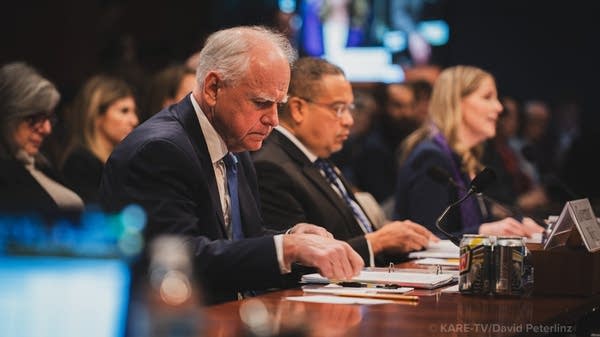
A new congressional report released Monday dissects internal problems in state government that could have allowed fraud to fester in Minnesota-run programs.
The 205-page report by Republicans who lead the U.S. House Committee on Oversight and Government Reform retraces fraud in nutrition and Medicaid programs and what was done about it. The report is based on documents and interviews with current and former officials in Gov. Tim Walz's administration as well as other levels of government.
The fraud cases the report revolves around have received public attention and investigative scrutiny for years. But the committee’s assertions are buttressed by interviews with high-level state officials whose agencies were confronting allegations or had to navigate a bureaucratic thicket when entities accused of fraud pushed back.
The report concludes warning signs were missed, authority to cut off payments wasn’t adequately used and employees who sought to act were silenced. The congressional panel examined Minnesota’s fraud cases because it involved federal money managed by state agencies.
“The failure to act decisively in the face of known fraud allowed criminal schemes to flourish and diverted resources away from eligible recipients: the vulnerable populations these programs were intended to serve,” the staff for the Republican-led U.S. House committee wrote.
Vice President JD Vance said on social media that he’s referred the report to a Department of Justice fraud division for possible prosecution. He wrote that if Minnesota officials “facilitated fraud or looked the other way while this theft was happening” or if they mistreated whistleblowers “they must be held accountable.”
The report includes recommendations that states and the federal government implement tighter controls to prevent fraud — some of which Minnesota legislators adopted in recent years.
Walz isn’t seeking a new term. But the report could be ammunition in other Minnesota political races, including for attorney general, U.S. Senate and the Legislature.
“This committee has proven time and time again to be nothing more than a joke. They continue to rehash COVID-era fraud to distract from endless wars, gas prices, ICE, and the president’s insider trading,” Teddy Tschann, a spokesperson for Walz. “Governor Walz is glad to see fraudsters are going to prison. If the committee is concerned about corruption, they should investigate why President Trump continues to let fraudsters out of prison.”
Walz’s office noted that several changes have been made over the last few years to address fraud, including new legislation creating an Office of the Inspector General, which will have independent power to investigate fraud.
Brian Evans, a spokesperson for Attorney General Keith Ellison, said, “Republicans in Congress issued a report riddled with inaccuracies and misrepresentations in an effort to politicize the issue of fraud, instead of actually helping Minnesota protect tax dollars and go after fraudsters.”
The attorney general’s office statement notes that 340 people have been criminally charged by that office over Medicaid fraud and that Ellison successfully petitioned the Legislature this year for reinforcements to the unit bringing those cases. Other types of fraud cases fall outside his jurisdiction, the statement said.
The report isn't focused on a specific program or fraud scheme: It covers documented problems in various health and social service programs, some dating to before Walz and Ellison took office in 2019 and some flagged as problematic as recently as 2025.
The House committee’s report goes into extensive detail about Minnesota government’s awareness of and action in response to the Feeding Our Future nutrition aid scheme, in which more than $250 million was stolen by people purporting to serve meals to needy children during COVID-19. Dozens of people have pleaded guilty or been convicted in the fraud with some serving lengthy prison sentences.
The committee also documented how fast-growing Medicaid programs susceptible to fraud, which is another avenue for ongoing state and federal prosecution against bad actors. In October of last year, Walz and the Minnesota Department of Human Services announced an additional level of review for 14 Medicaid programs that have been designated as high risk for potential fraud.
Several Walz administration officials sat for recorded interviews, including prior commissioners at DHS and the Department of Education. So did former Walz Chief of Staff Chris Schmitter, who the report’s authors note responded more than 260 times that he didn’t know, remember or recall aspects of the Walz administration response to fraud claims.
The report also describes contradictions between various officials on timelines for delving into allegations and steps taken to identify and combat fraud.
Republicans in Congress and in the Minnesota Legislature issued statements faulting Walz and Ellison, both DFLers, for failing to take fraud seriously at the outset and for acting aggressively only after it became a political problem.
The Trump administration has seized on fraud as an issue it intends to push in the midterm elections. It has also frozen hundreds of millions of dollars in Medicaid money to Minnesota until a corrective action plan and new program integrity safeguards are carried out.