
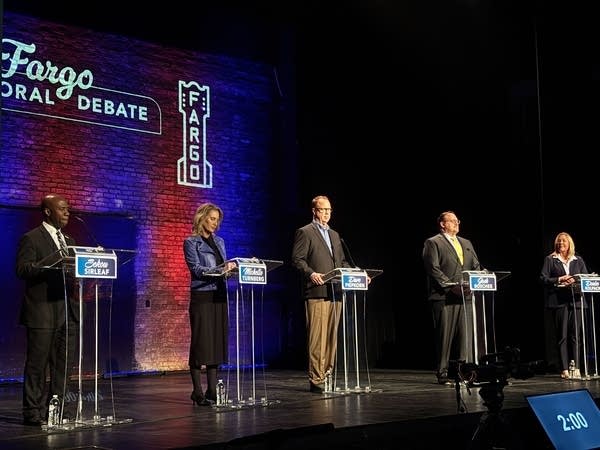
Fargo will select a new mayor and two other city commissioners Tuesday. Five candidates are vying to replace Mayor Tim Mahoney, who is term-limited, and eight candidates are running for the two open commission spots.
But voters will have fewer votes to dole out this time around.
It’s Fargo’s first election since the North Dakota Legislature forced it to stop using a new voting system called “approval voting” and go back to the old, traditional voting method. The last time it was used in Fargo was 2018, the same year Fargo voters overwhelmingly supported overhauling their voting system.
But what is approval voting?
“Approval voting is dead simple,” said Jed Limke, founder of Reform Fargo, the group that led the effort to switch to the voting system. “It's almost the same, but it's cleverly different just where it needs to be.”
The main difference is that under approval voting, voters can select multiple candidates.
“It's thumbs up or thumbs down to every candidate instead of just one,” Limke said. “Most votes wins.”
Supporters say that approval voting helps solve multiple issues that arise out of traditional voting, also called “first-past-the-post voting” or “plurality voting.”
For instance, when multiple like-minded candidates run in the same race, they run the risk of splitting their voters and handing the election to the other party.
That traditional method can also lead to candidates winning races while also getting only a small plurality of votes. In 2016, two Fargo City Commissioners were elected with 15 and 16 percent of the vote.
Results like that were the impetus for putting approval voting on the ballot, where more than 63 percent of Fargo voters approved it.
“We had a successful election using it in 2020, another one in 2022, another one in 2024; but already the pushback against us was starting to build,” Limke said.
That pushback came from the North Dakota Legislature.
In 2023, Representative Ben Koppelman sponsored a bill to ban approval voting statewide. He said it hurts principled candidates.
“It ends up electing candidates that pander to the middle, that kind of couch or hide what their real beliefs are,” he said.
His bill passed the Republican-led legislature but was vetoed by then-governor and fellow Republican Doug Bergum, who now heads the Department of Interior.
In his veto, Bergum called the legislature’s attempt to ban approval voting as “an egregious example of state overreach” that “infringes on local control.”
Koppelman said he’s sympathetic to that argument. But last year, he introduced another bill to kill approval voting, which ultimately passed. Gov. Kelly Armstrong signed it into law.
Koppelman said the legislature needed to step in because constitutional rights were at stake.
“If you allow [Fargo voters] to vote any way they want, then … not everybody's equally protected under the law across the state. Not everybody has the same constitutional rights to pick their one candidate,” he said.
What’s next?
As Fargo gears up for Tuesday’s election results and future elections using a more traditional method, experts said voters and parties need to do more political strategizing if they want to avoid splitting their votes.
“They need to make sure that there aren't three of one party against one another in the first place,” said Andrew Eggers, an expert on electoral systems and a political science professor at the University of Chicago.
This year’s election is pretty crowded, he said. Among the five candidates for mayor, a non-partisan role, two candidates are conservative, two are liberal and one is a moderate, broadly speaking.
Eggers said with that many candidates, there’s a real risk of someone with little support being elected.
“In a way, the system has already failed, because they should have winnowed the candidates down to fewer choices,” he said. “If you're going to have a [traditional] election, then it's really better to have it be among a smaller set of candidates.”