
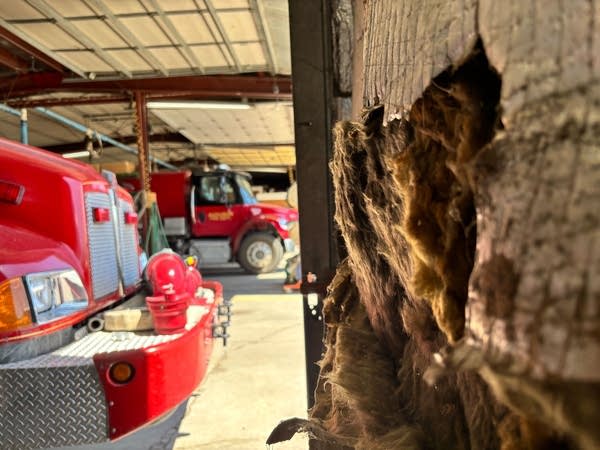
Set a ball down on one end of the Audubon fire station and it’ll start rolling. The sinking foundation will carry it past the firetrucks that barely squeeze into the garage doors. And it will pass the racks that are stuffed with firefighting gear because there’s nowhere else to put them.
Before long, the ball might hit the hall’s torn back walls, where insulation is poking out and officials say mold is spreading. But, most likely, the ball will be stopped in its tracks by the cracks in the garage floor.
The station was built in 1963, the same year the northwestern Minnesota town was incorporated. And the town has needed a new one for decades, said firefighter and former Chief Chris Wiedenmeyer.
“It doesn't meet any sort of standards for safety,” he said.
He’s particularly concerned about the diesel exhaust from the trucks.
Since the trucks are parked right in front of his firefighting gear, Wiedenmeyer’s worried about the carcinogens that latch onto his equipment every time the truck starts. In a modern fire station, the gear should be in a dedicated, ventilated storage area.
“It probably won't be long when cancer will pass as the number one leading cause of death for active firefighters, and a lot of these are being tied back to … what you're exposed to in your own fire hall,” he said.
Replacing the station would cost $3 million, a heavy lift for a town of less than 600 people. So the city council unanimously approved going forward with putting a 0.5 percent sales tax on the ballot. But first, they’d need approval from the Minnesota Legislature.
Unfortunately for Audubon, and more than 30 other local governments with similar plans for implementing new sales taxes, the tax bill passed by the Legislature did not approve any requests for sales taxes this year.
“I basically took it — when it failed again this time — that ‘nobody cares about you,’” Wiedenmeyer said. “‘You’re just taken for granted. You’re going to show up, you’re going to do that job, and we don’t care. We’re not going to support you.’ And that’s a real kick in the gut.”
What happened?
State Sen. Rob Kupec, DFL-Moorhead, introduced the proposal for an Audubon sales tax to the Senate’s Committee on Taxes.
“Some of these fire halls are just outdated, and there's lots of them across the state,” he said. “And instead of them coming and asking for a bonding request, they're looking for a way to fund it themselves.”
One advantage of implementing a sales tax, as opposed to increasing property taxes, is that it allows cities to earn money from people other than residents, such as visitors.
Kupec said the committee only approves requests if they have some sort of regional impact. For example, Audubon’s fire station serves multiple townships outside of city limits.
“Everything basically that came before us that met that criteria, the Senate tax committee OK’d,” he said.
The Senate committee’s version of the tax bill approved 37 local tax proposals, including Audubon’s. Other proposals included taxes to upgrade parks in Vergas, build a new judicial center in Waseca County and replace a Public Works facility in Robbinsdale.
The Minnesota House Taxes Committee also heard proposals, and co-chair Rep. Greg Davids, R-Preston, supported them.
“There are some very, very important ones,” he said. “The state of Minnesota wasn't able this year to give any more money to … cities. So I was of the opinion that, well, we can help these cities by allowing them a local option sales tax to build a fire hall, to build a community center, to build all the different things we looked at.”
But when it was time to finally pass a tax bill at the end of session, the House’s version hadn’t made it out of the committee. After the closed-door negotiations between the Senate and House settled, the omnibus tax bill passed without any approved sales taxes.
Davids wasn’t pleased.
“We put together a very good list of local option sales taxes,” he said. “They were vetted before the committee, and the Democrats in the Senate, the Republicans in the Senate and the Republicans in the House supported the local option sales taxes,” he said.
That leaves one group.
“At the end of the day, the Democrats in the House killed it,” Davids said. “You'd have to ask them why, because no one can figure it out.”
Rep. Aisha Gomez, DFL-Minneapolis, is the other co-chair of the House Tax Committee. She did not respond to MPR’s repeated requests for comment, but at an April hearing, she noted that sales taxes are considered regressive.
That means people with lower incomes pay a higher share of their earnings on the tax because they have less money to start with.
She also said funding public services through local sales taxes reinforces inequities between communities.
“Should only people who live with malls in their community or (a) big retail sales base have community centers? Have fire stations? Have the things in the bill?” Gomez said. “Or should we actually think about how it is that we equitably fund the basic public services that people need in a more thoughtful way?”
After Gomez finished her statement, Davids asked the testifying representative from Crosby, Minn., if the 2,000-person town had a mall, playing off of Gomez’s remark that only big towns with malls can raise money through a sales tax.
The representative from Crosby said no. No mall. But they still wanted a new sales tax to renovate a library, a community center, a park and the town’s city hall.
A long-running debate
Debates over local sales taxes are not new. Minnesota overhauled its tax system in the 1970s, when a series of laws dubbed the “Minnesota Miracle” reduced local taxes by providing more state school funding. It also created the modern Local Government Aid program.
“They put a prohibition in that cities could not enact other types of taxes, and then in the ‘90s this started to switch, where cities were coming to the legislature to get one-off authorization for special projects or different needs,” said Beth Johnston, lobbyist with the League of Minnesota Cities.
She said that’s when the framework was established that cities would have to get approval from the Legislature first before putting the idea before local voters. The process has changed a few times since, but the framework has largely stayed the same.
But the number of requests has been increasing. In 2023, lawmakers approved a record high of 32 new sales taxes.
“They also placed a moratorium on cities being able to come to the Legislature until this most recent legislative session,” Johnston said. “And in that meantime, there was a work group that came together to put recommendations for general authority for cities to collect sales taxes.”
Nothing came of those recommendations, so the two-year moratorium came and went without any changes.
Today, opinion is still split on what to do next. In her statement during the April hearing, Gomez said funding for public services should come out of a “statewide pot.”
By contrast, Kupec said the current system is a good one because it allows local governments to fund projects without costing the rest of the state, and local governments still need to win approval from their voters.
The League of Minnesota Cities wants to go further and give local governments more authority to fund certain capital projects themselves.
“The current process is definitely opaque,” Johnston said, “which (makes it) harder for cities to be able to plan and budget their capital needs.”
Davids would support the projects again next session but said success will probably depend on the result of this year’s elections.
“The Legislature will have a different makeup next year,” he said. “I'd say if the DFL is in control of the House under their current legislators, good luck.”
In Audubon's case, the city also isn’t sure what to do next. City officials said it will be prohibitively difficult to pay for a new fire station without a sales tax.
But Wiedenmeyer is pretty much over it. The fight for a new station is the main reason he stepped down as chief.
“It was a lot of time and a lot of extra work, meetings, township battles, funding battles, everything else,” he said. “All that extra stuff just kind of took a toll on me.”
Today, he’s still on the force as a volunteer firefighter, where he makes $15 a call. But the ongoing unaddressed health risks posed by the old station are weighing down his morale now, too.
“You come home, and you look at your family, and wonder, ‘Why keep doing it?’” he said. “When you get that thought in your head that nobody else cares, why should we keep doing it?”