
An agreement that paves the way to the Minnesota Legislature’s session finish includes help for a key Minneapolis hospital, cuts to vehicle registration fees and property tax relief for homeowners, according to terms released late Wednesday.
The pact between Gov. Tim Walz and top lawmakers will still need some massaging before bills are ready for final votes. Those must come by midnight on Sunday.
The outline calls for additional spending on education, debt service for infrastructure, technology upgrades for counties, a safety and security package and additional fraud investigators. It would leave available money from a projected surplus partly unspent to avoid budget problems later.
There will also be a rescue package for HCMC, a vital safety-net hospital in Minneapolis that is on shaky financial ground.
“I’m just incredibly proud how we were able to continue to make the investments we know we need to make, whether it's roads and bridges, education, Hennepin County Medical Center — that critical level one trauma center, dealing with the (federal) bill that came out of Congress that threw so much chaos into how we deal with Medicaid, food stamps and other things," Walz said Thursday.
"Then to deal with some of the issues that have been out there that we needed to get done, giving the tools necessary to fight fraud,” he continued.
GOP House Speaker Lisa Demuth, a candidate for governor, said the budget deal delivers cuts to vehicle registration fees and property tax aid. She said accountability for fraud and affordability were top concerns for lawmakers.
“These are good things that have come forward. Affordability for Minnesotans, fraud protection that is so desperately needed and investment going forward,” Demuth said.
DFL Senate Majority Leader Erin Murphy and House DFL Leader Zack Stephenson also lauded the package, with Murphy calling it a “hard-fought negotiation.”
Murphy said the state was responding to a number of difficult issues, from the implementation of a federal tax and spending bill that will affect public programs to the killing of former House Speaker Melissa Hortman.
“We're wanting to make sure that Minnesotans, to the best of our ability, get some support and relief from the things that they're experiencing because of so much that has happened that is outside of our control,” Murphy said.
Stephenson focused on the HCMC element as a key component.
“On the worst day of your life, you're very likely to end up at HCMC. And we want to make sure that that hospital is viable and sustainable in the long term future,” he said on Thursday. “And we took a very important step in that process yesterday.”
HCMC, other hospital stabilization
The assistance for HCMC includes $205 million in state support this year — and beyond that a $500 million reserve account available through 2031 to help ensure that the Minneapolis hospital remains open.
Another $30 million will be set aside to help stabilize other hospitals facing financial challenges.
Rep. Esther Agbaje, DFL-Minneapolis, said the agreement would also include additional oversight measures for the hospital, including a new task force to oversee funding sources for HCMC and sustainability moving forward.
“I think it will do a lot to stabilize them. What they’ve been telling us is that they need a lot of funding, especially with everything happening with uncompensated care, those costs exploding, UCare falling through, and also the incoming effects of HR 1,” Agbaje said, referencing the federal law passed last year that includes cuts to Medicaid. “We hope that this helps put them on a stable ground, level a runway for them to be able to then take off into the future.”
Gov. Tim Walz said the HCMC agreement is imperative.
“I'm proud of what we did, but I want to be very cautious on this,” he said. “This is only the beginning of the health and the hospital crisis across the country.”
Property tax relief
Sen. Grant Hauschild, DFL-Hermantown, who is vice chair of the Senate Taxes Committee, said in a statement that the agreement’s property tax relief component will total $125 million.
He said that “will deliver real help for approximately 600,000 Minnesotans who are struggling with rising property taxes and higher costs.”
The deal announced Wednesday night also includes agreement on a $1.2 billion bonding bill.
Missing from the joint statement and a signed offer sheet was Republican Senate Minority Leader Mark Johnson, whose caucus is essential for passing a construction projects bill given a higher vote threshold.
But Johnson issued a separate announcement heralding the cut to vehicle tab fees, which he said amounts to $250 million for a single year.
Gun debate and school safety
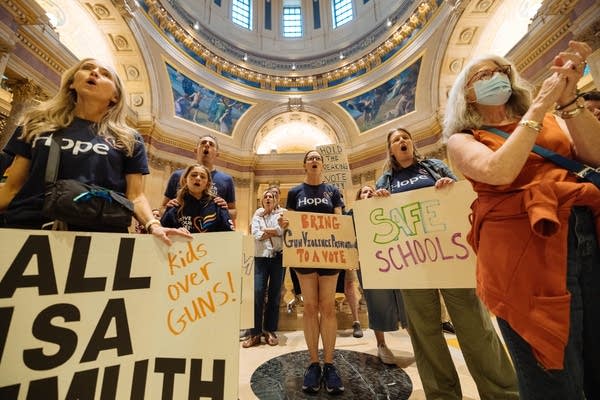
Something not in the deal is any action on gun restrictions.
A gun measure package passed in the Senate without Republican support May 4, but so far Minnesota House Speaker Lisa Demuth, R-Cold Spring, hasn’t allowed the bill to come to a floor vote.
The bill includes funding for school safety initiatives and mental health programs. It also would require owners of certain high-capacity, military-style guns to register them with the state and it restricts the sale of those guns.
Advocates, including members of Students Demand Action and Moms Demand Action, delivered a foot-high stack of letters signed by thousands demanding Demuth permit a floor vote.
The letter reads, in part: “No single law will prevent the rampant and excessive gun violence that has plagued countless Minnesota families. We recognize there is no singular solution that will save every life, but that reality does not excuse inaction.”
“Speaker Demuth, how many more Minnesotans need to beg for action before you allow this bill to come to a vote?” Timberlyn Mazeikis said before wheeling the stack of petitions into the House chamber.
Mazeikis survived the school shooting at Michigan State University in 2023 and is a Students Demand Action volunteer at the University of Minnesota.
“How many more communities have to experience tragedy? How many more students need to grow up afraid? How many more parents have to bury their children?” Mazeikis said.
“I think we all know it. If this bill comes to the House floor, it will pass,” Gov. Tim Walz said Thursday. “That's clearly why it's not coming to the House floor.”
Demuth said the gun restriction bills have failed in tied committees, which is why they didn’t come to a floor vote.
“We have taken bills up already on the same topics, individually within committee, that have failed on a party line vote,” Demuth said. “So we have absolutely taken votes. They just haven't turned in the way that we're hearing some people want.”
As part of the broader deal, lawmakers approved new funding for school-based mental health programs and anonymous threat reporting.
“We've been very clear since September that we are interested in finding bipartisan solutions to school safety as well as public official safety, that has been a high priority of the Republican Caucus,” House GOP Leader Harry Niska, of Ramsey, said. “We are in a tied House, and so we need bipartisan solutions to be able to go forward.”
DFL lawmakers pledged to stage a sit-in on the House floor Thursday night if the bill remains bottled up.
Advocates of the legislation rallied outside the House chambers Thursday evening as the House debated whether to let the bill face a vote or not. Some even brought snacks to fortify DFL lawmakers for the long night expected ahead.
“We know that they're planning to be here all night, we brought them snacks, we bought some things to drink. We want to support them any way we can,” said Kate Havelin, with Indivisible Twin Cities.
Wild arena complex
On the heels of losing a heartbreaking, season-ending loss to the Colorado Avalanche in the Stanley Cup playoffs, the Minnesota Wild got at least one small victory from legislative leaders Wednesday night.
The leader agreement includes $50 million in funding for renovations at Roy Wilkins Auditorium and Grand Casino Arena.
State officials say the agreement includes $40 million in bonding for Roy Wilkins Auditorium upgrades and $10 million in cash for Grand Casino Arena upgrades. Minnesota Management and Budget Commissioner Erin Campbell confirmed the details.
That doesn’t cover the request that the team and city of St. Paul made earlier this session. They jointly sought $200 million from the state — $125 million toward arena renovations and $75 million toward Roy Wilkins updates.
In total, the arena and auditorium upgrade plan is expected to cost around $525 million. The aim is to modernize both facilities.
Sen. Sandy Pappas, who heads the committee crafting the bill, issued a statement.
“As a St. Paulite, I am happy to see funds for the 100-year-old Roy Wilkins Auditorium and thank the Governor for his commitment to our historic treasure. Roy Wilkins serves the whole state — it plays host to high school basketball tournaments, college and high school graduation ceremonies, roller derby games, dance competitions, dogs shows and more.”
In a statement, St. Paul Mayor Kaohly Her said, “I remain always cautiously optimistic, and I trust the talented legislators, leaders, and staff to get this commitment across the finish line. We are grateful for their investment.”
The Minnesota Wild have yet to publicly weigh in.
Capitol and lawmaker security
The proposal also includes funding to maintain weapons-detection technology at the Capitol, along with additional security staffing beyond of the legislative session. The extra measures would run out next week without additional funding.
Legislative leaders also approved a proposal to allow for law enforcement to offer security for elected officials outside the Capitol complex if they face threats to their health or safety. Such threats have become increasingly common in recent years.
Public construction projects bill
Legislative leaders and the governor approved a $1.2 billion capital investment bill that will fund state and local construction projects. They didn’t spell out exactly what would be included in the package but said chairs of the capital investment committees would be tasked with hashing that out in coming days.
The committees fielded more than $7 billion in requests coming into the legislative session.
The bill is one of the tricker ones to pass because it requires three-fifths votes in both chambers to go forward. That means support from both parties is essential.
Johnson, the Senate GOP leader, said enough Republicans would vote for the bonding bill to pass it.
“We were very reluctant to go up to $1.2 billion unless we had a deal that was something that we thought our caucus could get behind and Minnesotans would agree with at the end of the day,” Johnson said. “And I think what we're looking at right now is a good package.”
This is a developing story. Please check back for updates.