
Capitol leaders struck an agreement late Wednesday on a range of lingering issues, from tools to combat fraud to construction borrowing to a package of tax cuts.
Precise details would still need to be sketched in and then the sprint to a Sunday midnight deadline for ratification will begin.
The outline released by Gov. Tim Walz and legislative leaders calls for additional spending on education, debt service for infrastructure, technology upgrades for counties, a safety and security package and additional fraud investigators. It would leave available money from a projected surplus partly unspent to avoid budget problems later.
There will also be a rescue package for HCMC.
“This agreement reflects the disciplined, fiscally responsible approach Minnesotans expect,” Walz said in a written statement. “We are keeping a balanced budget, making targeted reductions, and focusing every dollar on core priorities: fiscal sustainability, critical infrastructure, and the health and wellbeing of our communities.”
GOP House Speaker Lisa Demuth, a candidate for governor, said the budget deal delivers cuts to vehicle registration fees and property tax aid.
“With this budget, we’re delivering on affordability for communities across the state,” she said in a written statement. “This will help Minnesotans statewide afford their lives for years to come.”
Senate Majority Leader Erin Murphy and House DFL Leader Zack Stephenson also issued statements of support, with Murphy calling it a “hard-fought negotiation.”
Missing from the joint statement and a signed offer sheet was Senate Minority Leader Mark Johnson, whose caucus is essential for passing a construction projects bill given a higher vote threshold.
Johnson issued a separate announcement heralding the cut to vehicle tab fees, which he said amounts to $250 million for a single year. He also said enough Republicans would vote for the bonding bill to pass it.
On Wednesday, House and Senate lawmakers moved other items ahead while the top-level talks continued.
Lawmaker security
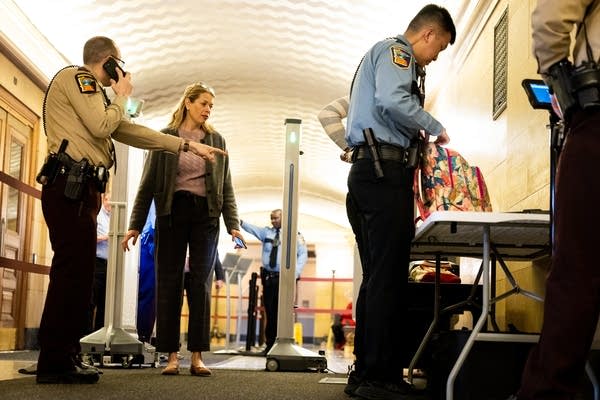
Both chambers of the Legislature have approved bills extending weapons screening at the state Capitol and adding new police protections for lawmakers and other state leaders when they’re away from the Capitol complex.
A conference committee has convened to talk through what should be included in the final bill.
The issue is a top priority for lawmakers who returned this legislative session after the assassination of former House DFL Leader Melissa Hortman and her husband, Mark, and the nonfatal shooting of state Sen. John Hoffman, DFL-Champlin, and his wife, Yvette. Lawmakers have to pass legislation before the legislative session comes to a close Monday.
Gov. Tim Walz’s administration implemented new weapons screening technology at the Capitol ahead of the legislative session but that’s set to run out next week. The Legislature is considering an extension and additional funding as part of a Capitol security and lawmaker safety measure.
Proposals that emerged from the House and Senate vary in terms of how to provide police security to lawmakers, constitutional officers and judges who face credible threats either at public buildings or when they’re in their home communities.
Conversations about a final proposal are expected to continue this week.
Ramsey County District Court Judge Richard Kyle, Jr., the president of the Minnesota District Judges Association, told the committee that judges and justices could use additional security safeguards as well.
“Colleagues from across the state have experienced a significant uptick in threatening behavior toward judges in recent years,” Kyle said.
Negotiators agreed there is a need to improve safety of lawmakers, judges and other state officials amid a heightened threat environment. But they noted they couldn’t advance a plan until they got a budget target from legislative leaders.
Leaders and Gov. Tim Walz have been meeting privately to reach a broader agreement on end-of-session priorities.
“I think throughout society we are experiencing, obviously, a really elevated level of threat. The sort of norms around people's behavior have really shifted, and it is very concerning,” Rep. Tina Liebling, DFL-Rochester, said. “We do have limited resources, and we want to deploy them in the most effective way and where the need really is. And so this issue of teasing out who needs what is really important.”
Tougher penalties for impersonating police
A proposal to toughen penalties for impersonating a police officer is on its way to the governor's desk for a signature.
The Minnesota Senate unanimously approved the bill on Wednesday. The vote comes after House DFL Leader Melissa Hortman was killed by a man disguised as an officer. DFL state Sen. John Hoffman was targeted by the same suspect.
“This bill helps reinforce trust in legitimate law enforcement officers in our state, and it sends a clear signal to people that will face stiff and severe consequences if they violate that trust,” Hoffman said. “When I answered the door on June 14, I did so because of the trust, and I never want another person in the state to have that trust shattered.”
Republican Sen. Jeff Howe, of Rockville, said it's important that lawmakers act.
"We need to make sure that others have that reassurance when they look out and see that vehicle or see that officer, that pro train themselves as that we are assured that they are that and we have trust,” Howe said.
Convictions under the policy could lead to prison time. Gov. Tim Walz is expected to sign the bill into law.
Housing funds
A housing finance deal is buttoned up and headed for the governor’s desk.
The deal, which was hammered out late Tuesday night by DFL and Republican members of the House and Senate, dedicates about $165 million to housing programs.
The price tag might look high, but the bill is budget neutral which earned it support from some Republicans.
The House passed it Wednesday on a vote of 105 to 28. Senators quickly followed with a 42-25 vote.
Among other measures, the bill appropriates $9 million for grants to organizations working to address homelessness in the state. It also contains money for bonds to build thousands of new housing units and a statewide tenant legal hotline.
“I am thrilled with this bill,” Rep. Nolan West, R-Blaine, said on the House floor.
“I have no notes,” Nolan added.
The final deal includes $4 million for the manufactured home park infrastructure grant and loan program to update aging manufactured home communities. However, legislation that manufactured home residents have been pushing for for years to limit lot rent increases and curb the influence of corporate mobile home park owners was not part of the final deal.
Rep. Liish Kozlowski, DFL-Duluth, was among the lawmakers who negotiated the deal. Kozlowski expressed disappointment Wednesday over the lack of a measure dubbed by advocates the “Manufactured Home Residents Bill of Rights.”
Residents testifying this session have described being priced out of their homes. Current law allows park owners to increase lot rent twice a year by any amount. Lot rent is the monthly rent paid for the land underneath a mobile home even if the resident owns the home.
“One resident we heard in testimony in conference committee said, ‘This used to be a place I love, and now it's just a place I live and feel trapped,’” Kozlowski said.
Kozlowski otherwise praised the bill, specifically lauding money to prevent homelessness by listing names of Minnesotans who have died while experiencing homelessness, including Kozlowski’s older brother.
“This bill is going to mean that less Minnesotans are sleeping in cars and out in the cold,” Kozlowski said.
“If you would have told us that a $165 million housing bill was going to be coming to agreement here at the waning days of session when we started this year, no one would have believed it,” Rep. Spencer Igo, R-Wabana Township, said during the Tuesday conference committee meeting.
Igo said he’s proud that the bill “doesn’t pick one group of people.”
“There's money in here to build single family homes, multi-family homes, manufactured housing. We've covered it all.”
Exoneration payment
A Minnesota man is one step closer to getting a settlement the largest exoneration claim ever given by the state after he spent more than 19 years of his life for a murder conviction that was overturned.
Marvin Haynes' was freed in 2023. He was convicted at 16 years old and spent nearly two decades in a state prison.
The Minnesota House voted unanimously on Wednesday for the biggest-of-its-kind exoneration award yet in Minnesota. Rep. Luke Frederick, DFL-Mankato, explained why.
“We cannot give him those years back, but we are able to put a financial recompense for that time that was taken away, which is why this year, this is the largest claims bill that we've had,” he said. “Four and a half million dollars will be going to him for the years that were unjustly taken.”
The Senate is expected to vote on a companion bill soon.
Egg expiration bill
The sell by date on eggs would no longer dictate when that staple can be donated under a bill passed by the Senate on Wednesday.
Senators gave unanimous approval to the bill after one of the more pun-filled floor debates this session.
"Let's not scramble it up,” said Republican Sen. Torrey Westrom of Elbow Lake. “This is no yolk."
The bill would allow chicken eggs to be donated up to 30 days past their quality assurance date, when they are still safe to eat. Several other states allow the same thing.
DFL Sen. Erin Maye Quade of Apple Valley also cooked up some zingers
"This bill is eggs-actly the type of legislation we should be doing,” she said. “We should scramble to our desks to vote green."
Sen. Ron Latz, DFL-St. Louis Park, couldn’t resist his chance.
"Although this bill is not all it's cracked up to be, if you vote green, you will experience a moment of egg-stasy."
The egg bill still needs approval in the House.
This is a developing story. Please check back for updates.