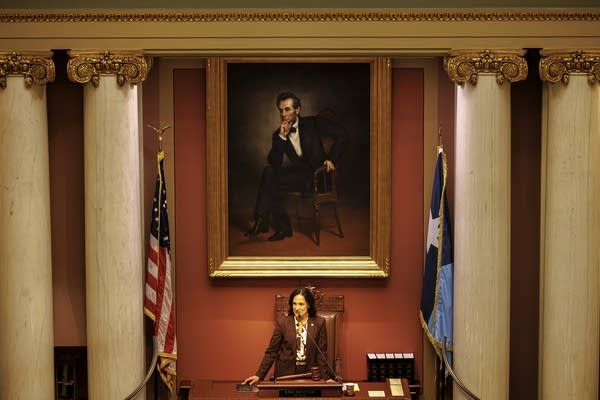
Little by little, agreements are coming together in the final week of the Minnesota Legislature’s session, including one to take on the fast-spreading use of prediction markets.
Lawmakers are racing to complete their work by Sunday night because Minnesota’s Constitution doesn’t allow them to approve legislation on the final day, which is Monday.
Negotiators from the closely divided Senate and the tied House picked away at lower-tier proposals while legislative leaders searched for the big deal that will pave the way for action on matters such as school and Capitol security, hospital stabilization and an array of publicly financed construction projects.
Prediction market ban
A proposal to ban prediction markets — like Kalshi and Polymarket — is headed to Gov. Tim Walz as part of a broader public safety bill agreed upon by House and Senate lawmakers.
Both chambers approved the bill Tuesday by substantial margins.
The proposal makes it a felony to host or advertise a prediction market in the state. The sites allow users to wager on a broad range of future events. People involved in creating, managing or facilitating the sites could face felony charges under the bill.
The legislation lays out some of the kinds of trades that lawmakers consider part of the wagering restrictions: athletic events, games of skill, wars or natural emergencies, actions by government entities such as criminal or civil trials and mass casualty events.
Bill supporters say the sites are effectively gambling platforms. But the sites don't pay state taxes and operate under commodity trading laws.
"We as a state should decide how best and what regulations we think should attach to gambling, to protect public safety, to protect our kids," said Rep. Emma Greenman, DFL-Minneapolis. "We are joining dozens of other states, red states and blue states, who are trying to both protect the public and protect our markets from the shadowy financial gambling markets."
Opponents anticipate lawsuits. The Commodity Futures Trading Commission has sued other states over regulations for the prediction market sites.
"We're going to see no gain for the public. We're going to see massive losses in our litigation costs related to losing a case against the federal government, and we're going to take away something that thousands of Minnesotans already do - for nothing, just doesn't make any sense," said Rep. Nolan West, R-Blaine.
Social media controls
Final consideration is also ahead on bills to require age monitoring and verification of users of social media platforms.
The proposal, which passed in the House by a 132-2 vote, would require parental approval to create an account for a child under 16 years of age. Targeted paid ads and more addictive features like infinite scrolling cannot be displayed for children’s accounts. The bill is up next in a key committee in the Senate on Wednesday.
Rep. Peggy Scott, R-Andover, has been spearheading the legislation in the House. Scott told MPR News’ Morning Edition on Tuesday that an important aspect to the bill is it’s not “content focused” it’s “design focused.”
“If a parent approves a social media account for their kid that's under 16 years old, that account will look different,” Scott said.
“The push notifications, the infinite scrolling, the ads, those sorts of things will be gone.”
For Scott, the goal of this bill is simple: “I'm hoping to prevent addiction.” Scott says she’s seen the toll on children's mental health and safety that social media can take.
During floor debate Tuesday, the House added a requirement that social media companies report to the state any credible threats of harm to a person. Reps. Andy Smith, DFL-Rochester, and Andrew Myers, R-Tonka Bay, teamed up on that change.
“We can actually have an impact on community safety, school safety, within places of worship,” Myers said.
Rep. Emma Greenman, DFL-Minneapolis, led a failed effort to specify in the bill that social media companies should be on the lookout for threats of mass shootings and as part of their threat assessment they should consider “whether the threat includes a reference to or picture or video of a semiautomatic military-style assault weapon.”
Greenman said to prevent gun violence, “We actually have to look at and talk about the weapons designed for war that make this uniquely American problem a problem.”
Rep. Kristin Bahner, DFL-Maple Grove, said Minnesota is poised to take a step other states haven’t.
“The reality is we will get sued,” Bahner said. “That's certainly not a reason to not take the first steps to protect kids. In fact, I would argue we should do it anyway.”
The Senate version also has bipartisan support, but it needs clearance by that chamber’s Rules and Administration Committee to move ahead because it came together after committee deadlines. That consideration is happening on Wednesday.
Penalties for impersonating police
State lawmakers are primed to boost the penalty for impersonating a police officer following a fatal shooting of a former House speaker and wounding of another legislator.
House DFL Leader Melissa Hortman was killed by a man disguised as an officer. State Sen. John Hoffman, DFL-Champlin, was targeted by the same suspect. Both of their spouses were also shot, with Mark Hortman fatally struck.
Hoffman said impersonating an officer is a serious offense and the penalty should be hiked to reflect that. On Tuesday, Hoffman described to his colleagues in the Senate Finance Committee the moment of confusion he experienced when he opened his door in the middle of the night to someone he thought was law enforcement. Hoffman saw “all the necessary lights and sirens and looking like that person was a police officer,” but as soon as he realized the man wasn’t police, “that was when I first received that first bullet, and then eight after that."
Convictions could lead to prison time. The House passed the bill unanimously in April and a final vote on the proposal on the Senate floor is expected this week.
Vance Boelter faces multiple federal charges and remains jailed.
E-bike safety
A bill that would ramp up safety around e-bikes cleared the Senate Finance Committee on Tuesday with bipartisan support.
The legislation would require anyone under 18 to wear a helmet while riding an e-bike and closes a loophole sellers use to sell motorcycles as e-bikes. Sen. Ann Johnson Stewart, DFL- Minnetonka, is the chief sponsor in the Senate. Johnson Stewart said communities across Minnesota are seeing the use of e-bikes spreading, especially among kids.
“These e-bikes are being used by children who are not legal to ride them. They're traveling very fast and very unsafely. They don't have helmets,” she said.
Johnson Stewart said safety on e-bikes is a high priority for several city officials and more guardrails are needed.
A few lawmakers pushed for clarity around the distinction between an e-bike, a motorized bicycle and a motorcycle. One of them, Sen. Eric Pratt, R-Prior Lake, questioned the call to hire a state bike safety coordinator.
“This seems like it's kind of a make-work position,” he said.
The bill is now headed to the Senate floor.
This is a developing story. Check back for updates on other proposals moving forward throughout the day.