
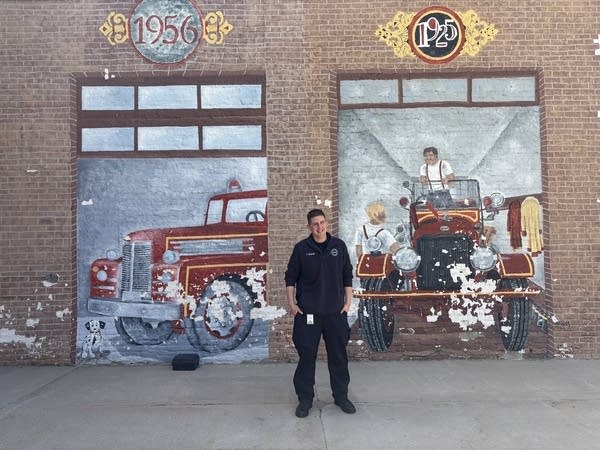
With its two towers and large, rounded glass windows, Owatonna’s 120-year-old fire station looms over the city’s downtown. Murals depicting fire trucks of the past decorate the building’s brick walls.
“I love how it looks,” said interim fire chief Jacob Dashiell. “The downside is we're pretty landlocked, so we can't add on to it any farther.”
The facility is so old that when it opened, the fire department still used horses. And it’s so small that the fire department can’t even keep all their vehicles on site. Some are out at the airport.
“We just don't have room for them,” he said. “Depending on what the call is, we could actually end up having to send a firefighter out to a different location, pick up something, come back here. If it was like a big fire situation, it increases the time it takes for us to get to you. And that is a problem.”
And there are other problems, said Dashiell. There’s nowhere for firefighters to change and shower after a fire call. Training space is limited. Water sometimes leaks from the ceiling.
Dashiell said his department needs a new, modern and fully equipped fire station to serve this growing community of nearly 30,000 residents, and the Owatonna’s police department sorely needs a new home too, as the city's 60-year-old police station is similarly out of date and in need of repair.
The building is a former bank, built in the 1960s. There are only two rooms to question suspects and witnesses, and one of them is a retrofitted closet. Victims coming into the station need to wait in an open lobby without privacy. They have water leaks, too.
City officials say fixing and repairing the two aging structures would essentially be throwing money away, so instead of renovating these properties, the city council approved a plan earlier this year to issue $65 million in bonds to pay for new facilities. Those bonds would be paid off over two decades with tax dollars. That means the owner of a $300,000 home would be hit with a $420 annual property tax increase.
Projects that serve public safety are usually popular. But some Owatonna residents are fighting the plan to build new police and fire stations because they feel like the city made a decision without their input during the multi-year process.
Resident Melissa Zimmerman helped lead a successful effort to put the question of whether the city should move forward on the projects to the voters. She’s unhappy with how the process has played out at City Hall.
“It’s always been about transparency, accountability and public input,” Zimmerman said, “Where does the public have a voice in government? And at the end of four years here, I still don't know where our voice belongs.”
A new facility on a historic site
Cost and location are a primary concern for people who signed the petition.
Carl Wieman is one of them. While the new fire station would be built on the old police station site, the new police station would be moved to a large treelined greenspace right beyond his backyard.
It's owned by the city but listed on the National Register of Historic Places because it was once the site of a state school. That means the state historic preservation office will have to weigh in on the city’s plans, too.
As he looked out onto his backyard, Weiman said he worries the construction will damage the bucolic scene.
"There will be underground parking for the patrol cars with upstairs offices,” he said. “It's going to take all of these trees out. Ninety-eight of them."
A city official confirmed that they would need to cut down approximately 98 trees to build the facility.
Wieman said he first learned about the project from a neighbor - not the city. And he doesn’t trust that his elected officials and city staff are doing what’s in the best interest of his community.
Neither does 88-year-old Myrtle Schrader. She's lived in Owatonna her whole life and never been very politically active - until now. She says the cost to taxpayers is too much.
"This is not a democracy. This is not how democracy works,” she said. “[The city said], ‘This is what's going to happen, and you're going to pay for it,’ and that's not what we elected these people for."
A question of transparency
Melissa Zimmerman is a stay-at-home mom. But holding local officials accountable has become a full-time job for her. A few years ago, she and some concerned neighbors started asking county officials for more information about a road project near their homes.
But Zimmerman said county officials didn’t adequately address their concerns, so they filed data practices requests. Late last year, a judge ruled that Steele County officials violated Minnesota’s public data laws in dealing with requests from the group.
“Through that process, we have essentially been forced to learn the laws, and in doing so, we were able to then expand that into other areas to help the rest of the community,” including the police and fire station projects, said Zimmerman.
Their activism has become less about the actual projects, and more about making sure community members have a say in them.
“This has never once been about being against police and fire,” she said. “They are vital to our community, and we are pro police and fire. However, the public needs to have a voice.”
Mayor Matt Jessop pushed back on claims that the city has shut resident voices out of their decision making.
"I don't think it's necessarily an issue of transparency. It's more people getting information in the medium that they want to get it in,” he said. “We're on the radio, we're in the newspapers, we are on social media. We have information on our website."
Earlier this week, the city held a public meeting to show residents how they chose the project's locations - and why construction will cost as much as it does.
Jessop said those efforts will continue as voters weigh the merits.
"It's a lot of money, but it's also something that's very necessary,” he said. “You know, if the vote is no, these needs don't go away."
The city council will decide in coming weeks when to put the question to voters - either in August or in November during the general election.