
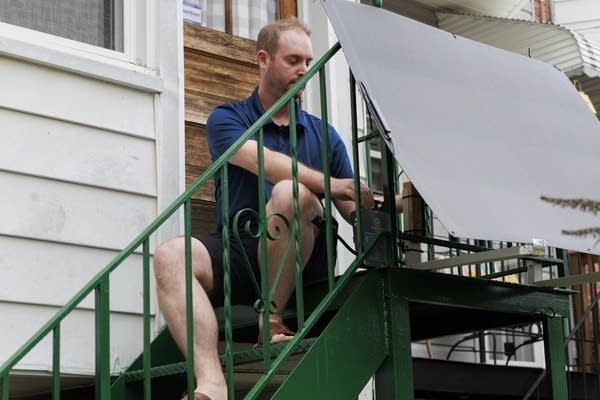
Darrel Veldhouse has always been interested in alternative energy. It started when he was a farm kid growing up in western Minnesota and corn was beginning to be grown to make ethanol to help fuel cars and trucks.
The 63-year old Dilworth resident now drives a plug-in hybrid. He’s looked at installing solar panels to power his home. But his roof can’t support the panels. And the price tag would be prohibitive.
"It would cost a lot of money because we'd have to upgrade our entire electrical system, and we just can't afford to do that,” Veldouse said. Residential solar systems can cost $20-$30,000 or more.
But now there’s an attractive alternative for homeowners like Veldouse — whose properties aren’t good fits for a big solar panel installation — or for renters who don’t own their rooftops. It’s called “plug-in” or “balcony” solar.
The smaller systems consist of just a few solar panels that can be placed on a deck or balcony or mounted on the ground outside a home. The systems reverse the typical flow of electricity– instead of pulling power off the grid, plug in solar pushes power back into the outlet and into the home’s wires.
A typical plug-in solar system set-up costs around $1,000 to $2,000 and can power a few appliances such as a refrigerator and modem. They usually provide about 20 percent of the electricity used by a typical home.
The technology has taken off in Germany in recent years. There are over a million of the mini-solar systems installed there.
“The price of electricity is going up, and this could help alleviate that problem for people," Veldhouse reasoned. So he went to a town hall meeting hosted by Democratic State Sen. Rob Kupec of nearby Moorhead and gave him some information on the technology.
“I knew nothing about it,” Kupec recalled. But he was intrigued. And the more he learned about it, the more it seemed to make sense.
“For those people who live in apartments who can't put up a solar array, or if your house just doesn't take one, it's a great opportunity,” Kupec said.
But to install one of these mini-solar systems now in Minnesota, a homeowner would have to jump through all the same interconnection hoops with their power provider and pay the same fees as someone putting in a big rooftop system. That can be costly, time-consuming and complicated.
Kupec has introduced a bill in the Minnesota Senate to streamline that interconnection process for certified plug-in solar systems. It's the companion legislation to a proposal from State Rep. Larry Kraft, a Democrat from St. Louis Park. Kraft told MPR News he's never seen so much excitement around a clean energy bill.
"It's a great thing for energy affordability, and it's also just a great thing for individual freedom,” Kraft said, for people who want to tap into the power of the sun that’s shining on their property.
That notion of personal freedom and consumer choice broadened the appeal of plug-in solar. Clean energy policy has become deeply partisan. But deep-red Utah was the first state to adopt a plug-in solar law last year. It was introduced by a Republican legislator and passed unanimously. A handful of other states followed suit this spring. And about 20 additional states, including Minnesota, are considering similar laws to allow residents to install plug-in solar systems.
Still, some in the state legislature have expressed safety concerns, because the technology reverses the flow of electricity and sends it back into a home’s electric wiring.
"I just think this year is too early to adopt this,” said Jason Rarick, a GOP State Sen. from Pine City who is also an electrician. Rarick wants to make sure proper safety procedures are in place for installation “before we're actually promoting people to start using it here."
A new safety standard was recently developed to certify plug-in solar equipment. But Rarick said that hasn’t yet been incorporated into the National Electrical Code.
Rarick also thinks the technology needs to be rebranded. “Because it's not going to be plug-in solar,” he said. “There's just no way to make that work.” He said, in most cases, an electrician will need to hook up the systems. Still, Rarick says it’s a matter of when, not if, the legislation will pass.
“This is something that’s absolutely coming,” he said. “Once the proper procedures have been followed to get this right, I'll be 100 percent behind it. Because it's not a mandate, and it's just giving people options.”
Kraft agrees homeowners will likely need to hire an electrician to set it up. But eventually, consumers will likely be able to purchase a small-scale system at Menards or Home Depot, said John Goeke, a Duluth electrician who specializes in installing solar and battery systems and who advocated for the bill at the state legislature.
“When you start to conceptualize how much power the sun is producing on a daily basis, on every square inch of land, you start to realize every plot of land is its own fortress, or its own microgrid,” he said.
The proposal is still alive in the Minnesota Senate. But advocates concede it has a narrow path to approval in a closely divided legislature.
“If we aren't successful with passing it this year, we will absolutely be coming back next year, and we'll have a better shot, probably, of getting it done,” said Patty O'Keefe, Midwest Regional Director for Vote Solar.
Back In Dilworth, Darrel Veldhouse isn’t waiting around. He’s already bought plug-in solar panels. He's confident the law will eventually pass, whether it’s this year or next.
“It should not be a partisan issue” for legislators, Veldhouse said. “Their constituents are facing growing expenditures on electricity. I hope that they would understand that.”