
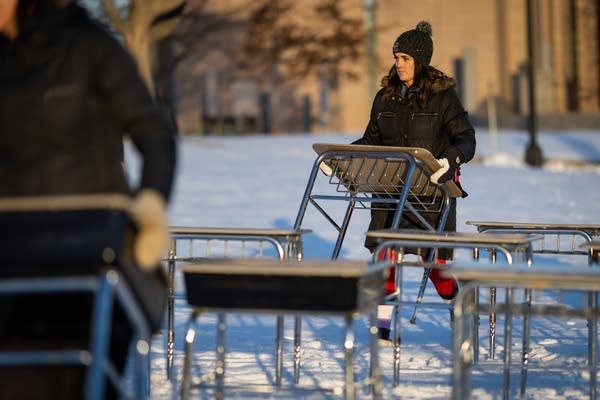
State lawmakers returned to the Capitol this year vowing to address school safety in the wake of the Annunciation Catholic Church and School in August.
But with a month left in the legislative session, they’ve yet to coalesce around a proposal that can pass the narrowly split Capitol.
Across party lines, lawmakers agree that more funding is needed to augment safety in schools — and districts should adopt plans for violent incidents and implement anonymous reporting systems to flag potential threats.
The disputes are around the way to distribute a yet-decided pot of money. They’re also not in harmony about whether to recommend them or to require them. DFL efforts to restrict access to firearms have so far stalled without Republican support.
Here’s a look at what’s in consideration and what might make it over the finish line.
School safety funding
Gov. Tim Walz and lawmakers in both chambers are proposing additional money, but who would receive the funding and what could be covered varies in the proposals.
House Republicans have pitched additional school safety funding for traditional public, charter, private and tribal schools. That could cover more school safety officers, harden schools against potential intruders or pay for additional mental health counselors. They say it’s important to direct funding to all schools given previous shootings have occurred at public, private and tribal schools in Minnesota.
“To make school safer for every student in the state of Minnesota – and that's the key for us today is addressing the safety of all kids in our schools,” said Rep. Bryan Lawrence, R-Princeton.
Senate Democrats and Walz also proposed school safety funding to public and nonpublic schools. Walz’s proposal would earmark $5 million to the school safety center and school safety grants in this budget and $10 million in the next. The Senate is proposing a one-time $40 million round of grants.
House Democrats, meanwhile, are recommending more money to public and charter schools with a focus on adding support personnel that work in mental health. They point to research on school shooters that suggest most are students or former students. So they say rather than focusing on bulletproof doors or barriers, lawmakers should fund people that can help young people deal with challenging things in their lives.
“Do we want them to experience entering into a `hardened complex?’ Or do we want them to experience a caring and supportive environment where they are known, where they are supported and where they are taken care of?” Rep. Josiah Hill, DFL- Stillwater. “Allowing students, districts and charters to move away from having those professionals onsite to care for our kids and to educate our kids to put in bulletproof glass or other features that would harden the structure comes at quite a cost.”
The size and funding source of the school safety money is also a point of contention in the House.
With limited dollars available this year, lawmakers are also grappling with where to find money for the potential safety grants. That could be part of a broader budgeting discussion in the final weeks of the session.
Threat reporting systems
Both parties also agree on creating an evidence-based school safety plan and having school districts put individual plans based on that state model. But there’s a snag around whether they would be compelled to do that or whether they should just be strongly encouraged.
Democrats said the state should require schools create school safety plans and set up anonymous reporting systems or direct the school community to the state’s reporting system. House Education Finance Committee Co-Chair Cheryl Youakim said the issue is urgent given the potential danger that schools face.
“We're to a point now that we do have to say it has to be done. We have to start this process now. We can't keep waiting,” Youakim said. “Childhood doesn't have a rewind, and we can't have a whole other generation being afraid when they go to school.”
Republicans agreed those reporting systems and safety plans should be put in place. But they said schools are already facing too many mandates. Instead, they recommend districts take these steps rather than require it.
“We want schools to be able to have the option to opt into a good thing,” said Rep. Peggy Bennett, R-Albert Lea. “They're smart enough. They can figure this out. They can see what good things are. There's no need to mandate that our schools are so over mandated right now.”
Proposed restrictions on firearms
Democrats want to ban assault-style weapons and high-capacity magazines. But those have stalled so far in the tied House. Despite that, DFL leaders plan to keep pressing forward because as a piece of the school safety equation.
The House DFL safety proposal would also require locking up firearms on school campuses and prohibit possession of a firearm on school property or during school activities if posted signs say firearms are not allowed.
“We want to do something meaningful on school safety, but that requires taking seriously the issue of guns,” said House DFL Leader Zack Stephenson. “We will continue to support keeping our schools safe, but the idea that we can't do anything on guns is anathema to most Minnesotans.”
School suspension options for young students
House Republicans propose restoring the option to suspend students in kindergarten through third grade when they act out in violent ways. They said other students and teachers can be put in harm’s way when they lack the ability to remove students from the classroom.
“The educators across the state are begging you to listen to what is happening,” Rep. Ben Bakeberg, R-Jordan, said. “Those are educators being hurt by kids. We talk a lot about retention and growing our workforce. It starts with respecting educators.”
Democrats argue students need more support in schools, not a step to remove them.
What are lawmakers saying about a final compromise?
Leaders of the tied House Education Finance Committee said they’re prepared to work together on a compromise school safety package.
“I think it's a has to get it done,” House Education Committee Co-Chair Ron Kresha said. “I think if we were to finally close out the session in May and my head were to hit the pillow that night and we didn't get a school safety package done, that would be a great sense of sadness.”
Youakim, a Hopkins DFLer, agreed they could reach an agreement if given time to negotiate in advance of the May 18 adjournment deadline.
“I know if we sat in a room for a day, we could get this done,” Youakim said. “I look forward to that. And you know, really it is not too late for our community to come together and pass a multi-layered approach to school safety.”