
One essential ingredient for success in the 2026 session? Buddying up with a lawmaker from the other party.
While partisanship has dominated much of what has and — more importantly — has not moved along this session, outlier proposals are advancing thanks to across-the-aisle collaboration.
The Legislature is as closely divided as ever: At 67-67 between the parties in the House and 34-33 in favor of DFLers in the Senate.
There are several examples, but among the most common places for common ground are bills focused on putting brakes on technology and gambling. There are bills aimed at protecting minors using artificial intelligence (AI) chatbots, a bill that would require public official economic interest disclosures to include cryptocurrency holdings and a bill to prohibit therapists from using AI in making therapeutic decisions.
A bill to ban crypto currency kiosks — a regulatory hammer that some lawmakers typically flinch at — passed the Senate by a 57-10 vote last week. The companion bill, also with bipartisan backing, awaits a final House vote
Only four bills have made it into law so far this year, but others are on the doorstep. In almost every one of those cases, lawmakers are crossing the aisle to shape or write the bills.
"Good legislators are able to silo different issues,” said Rep. Drew Roach, R-Farmington, who is pairing with a House Democrat on a bill on non-disclosure agreements in economic development projects. “And we may not agree on everything, but we agree on something. We need to set the other differences aside and get good legislation across the finish line."
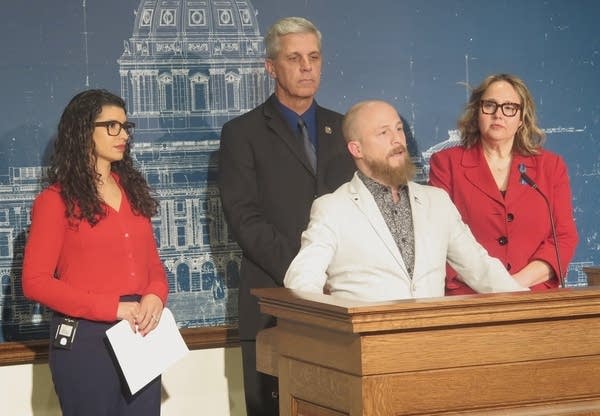
Roach and Rep. Emma Greenman, DFL-Minneapolis, are a bit of an odd political partnership.
The two agree on very little. But they forged a partnership as both started hearing from constituents about local governments signing non-disclosure agreements with companies hoping to keep major projects out of the public eye.
“It’s brought together folks from across the political spectrum, including us,” Greenman said last week. Greenman and Roach talked about the bill alongside an equally mismatched pair of Senate sponsors. Sen. Erin Maye Quade, DFL-Apple Valley made light of the fact she typically has little philosophical overlap with Sen. Steve Drazkowski, R-Mazeppa.
“This does not fall along partisan lines, and that’s because NDAs aren’t being used in just blue cities and townships or red cities and townships,” Maye Quade said. “There really aren’t that many, if any, other Maye Quade/Drazkowski bills out there, so drink it in. But this is one of those bills because we know that public transparency is so important.”
The bill had been humming along, but late last week hit a snag. A House committee divided along party lines to stop it. While the bill has several GOP co-authors, Republican members of the House Judiciary Finance panel did not approve its passage through the committee.
It could take special procedural maneuvering to revive. The companion bill awaits a final Senate vote.
Drazkowski said a similar measure last session found “bipartisan support and bipartisan opposition. It’s one of those issues where you are going to see that.”
“In the Senate, we are seeing momentum growing with additional support happening,” he said. “So I think the bipartisan support part is growing to be bigger than the bipartisan opposition.”
Another bill that threads that same needle deals with online prediction markets, like Polymarket and Kalshi, where people can put money on anything from the weather to sports to political outcomes or when a war might end.
Greenman is involved there, too. Her bill would make it a felony to host or advertise a prediction market in Minnesota.
“States around the country — red states, blue states — are responding to these prediction markets by bringing law enforcement action, and that's what this legislation does,” she said. “It allows us to protect our current regulatory framework in Minnesota by defining what prediction markets are and outlawing them.”
Rep. Greg Davids, R-Preston, is a fan of the bill and put his name on it.
“This bill makes all the sense in the world,” Davids said. “This is a huge, huge expansion of gaming and unregulated and I think eventually, hopefully, we can all support the Greenman bill and get it moving forward.”
But Davids worries the bill got moving too late to gain approval this session.
With about a month to go, the crossover tandems will soon know if their willingness to step across the aisle is enough to land their ideas on the governor’s desk.