
Wednesday afternoon, Mayor Jacob Frey signed an executive order that prohibits “federal, state, and local agencies from using any City-owned parking lots, ramps, garages, or vacant lots to stage civil immigration enforcement operations.”
The order also directs city staff to start developing signs for business and property owners that indicate their property is off-limits for federal civil immigration enforcement activities as well as express their support for immigrants.
In a press release, the mayor said the action is similar to one taken in Chicago to block ICE agents from using municipal lots to stage operations there.
The order comes as members of the Somali community in the Twin Cities report seeing an increased presence of federal immigration officials, and a day after initial reports that the Trump administration is planning an immigration enforcement operation in Minnesota.
The Associated Press, the New York Times and other outlets on Tuesday reported that the enforcement operation would focus on members of the Somali community in the Twin Cities who have final deportation orders — estimated by the AP to number in the hundreds. Tens of thousands of Somali immigrants live in Minnesota, and most are U.S. citizens.
Reports of agents questioning U.S. citizens
Speaking at a news conference Wednesday morning, Jaylani Hussein, executive director of the Minnesota chapter of the Council on American-Islamic Relations, said the community has reported an increased presence of U.S. Immigration and Customs Enforcement personnel in the Twin Cities. He also said he’s received reports of “U.S. citizens being asked about their citizenship.”
City leaders had expressed concerns Tuesday that any federal operation would be indiscriminate, and would result in American citizens being detained.
At Wednesday’s news conference, Hussein urged members of the Somali community to know their legal rights.
“The strategy by this administration is to create panic,” Hussein said. “We've seen that, the way that they operate, the way they present information, and obviously right now we have a president who is refusing to stop demonizing an entire community.”
And he called on others to stand up and show support for their Somali friends and neighbors.
“We are not backing down. We’re not afraid. And most importantly, for most Somalis, we’re citizens. We’re not going anywhere,” Hussein said.
“This is our home. This is our country, and we’re going to do everything possible to ensure that we fight for inclusion, just like many others in this country have fought — from Irish to Italians to other community members who were targeted severely in other immigration efforts, including our Japanese-American community and others.”
Michele Garnett McKenzie is the executive director at the Advocates for Human Rights, an organization that provides free legal services to asylum seekers. She said Somali residents should make a plan for what to do if they’re stopped by an immigration official.
“It's very important for people right now to plan to take a look at their own immigration status and their own immigration case,” McKenzie said. “That readiness is going to be really important to making sure people access what the law allows them to do.”
For Somali immigrants who are still in the process of obtaining legal status, she said, that means getting in touch with an attorney.
Advocates said they are distributing information to Somali communities about their rights when approached by immigration enforcement agents — including not opening the door if officers don’t have a warrant, and not answering questions.
Extra caution within community, carrying passports and laying low
State Sen. Omar Fateh told MPR News host Nina Moini that President Trump’s rhetoric is exacerbating fear among members of the Somali community who have lived their entire lives in Minnesota.
“There are some young folks that I spoke to that have never even been to Somalia, but now they feel the need to carry their documentation on them,” he said, “because of the shameful and hateful rhetoric that they're hearing from the federal government.”
Imam Hassan Jama of the Alhikma Islamic Center also said Somali Americans are carrying passports in case they are stopped based on their appearance.
“This is not who we are as a nation. I myself, before I left my home this morning, I have to have my passport card. It's race targeting. It’s singling out one community,” he said.
He said fear is also driving Somali people to stay home.
“Last night, I went to a restaurant on Lake Street, and I saw only two people. It's a well-known Somali restaurant, usually very busy, 6:00, 7:00 p.m. and it was very quiet,” he said. “When I asked the restaurant owner what's going on tonight. He says, ‘people are scared to come out.’”
Mukhtar Abdulkadir, a Minneapolis police sergeant with the department’s community engagement team, urged people not to be deterred from calling the police when they need help.
“We don't want you to be afraid to call 911, we will come. We don't care where you came from or what papers do you have. We will serve you like we always have done,” he said. Abdulkadir added that if someone who appears to be with MPD comes to the door, people can call 911 to verify the officer’s identity.
Sen. Fateh said in the upcoming legislative session, he would renew a push to bar all local and state law enforcement in Minnesota from helping with federal immigration enforcement. He co-authored the bill called the North Star Act in the last legislative session but it did not pass.
“I think that there might be more of an appetite to reintroduce that and to restart that conversation, because right now we have a hostile federal government that's not only talking about immigration enforcement, but attacking all immigrants, all Somalis, regardless of documentation status,” he said.
Neighbors patrol Minneapolis schools
In response to immigration enforcement, people are posting up outside Minneapolis schools with significant Somali and Latino student populations to monitor potential immigration enforcement. Wednesday, a handful of volunteers stood on corners before and after school in below-freezing temperatures.
Valerie J., a retired mental health nurse, joined her neighbors in patrolling. She said they watched from different directions, on the lookout for ICE agents that might be targeting students.
“We need to protect these people. Our neighbors. Our community,” she said. Several different groups are involved with the patrol efforts. Volunteers told MPR News they plan to continue their watch in the coming days.
At Karmel Mall, visitors navigate fear and solidarity
Karmel Mall in Minneapolis is known for its outdoor signs towering over Lake Street that are painted in the blue and white colors of the Somali flag. The sprawling complex is home to dozens and dozens of businesses, including coffee shops, clothing stores and dental offices. For about two decades, it’s been a mainstay of Minneapolis’ Somali community.
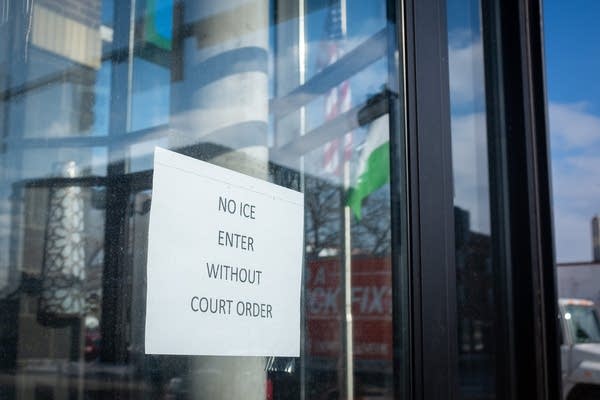
On Wednesday, a stark sign was taped to each entrance to the mall: “No ICE enter without court order.”
Trump’s characterization of Minnesota’s Somali community as “garbage” has riled frequent visitors to the building.
Sadak Elmi travels all around the Twin Cities for his job as a salesperson. He was shocked to see the comments about Somalis from the president. His son was born in the United States.
“We do not come here to do bad to the people. We come here with only one purpose, peace and democracy,” Elmi said. “We should be united and equal. We are Somali-Americans. We have a right to stay here, and we have a right to live here.”
He said people drink tea and express fear about what’s happening with the immigration crackdown on Somali Americans, wondering if they too will be subject to the ICE tactics that they’ve seen frequently used in other states.
“I know my rights,” Elmi said. “But what it looks like [for] all the people, the vulnerable people, those are the one we're worried about.”
Minnesota is home to an estimated 80,000 Somali Americans, the largest Somali population in the United States. The vast majority are U.S. citizens. Local advocates estimate that a few hundred people in the state could be directly affected by the reported plan to crack down on Somali Americans with pending removal orders and another few hundred have temporary protected status, which the Trump administration has called to end for Somali nationals.
On Wednesday, as social media exploded with reports of purported ICE vehicles in the neighborhood, the mall was less busy than usual, which many shopkeepers attributed partly to the frigid and snowy weather and partly to some people’s fears they’d be targeted by ICE, whether or not they had citizenship issues.
In his second-floor electronics repair shop at Karmel Mall, Goth Ali said some people are scared, but many are heartened by the support they have been receiving from elected officials in the state, from the governor to local city council members.
“We belong here. It doesn't matter what the other people said,” Ali said. “But we're here. We're part of this community. We're part of this country, so we won't go anywhere.”